There is a particular kind of confidence that belongs to a small JavaScript project.
You open a file, write a function, refresh the browser, and the thing works. The language stays close to the machine of the web. Nothing stands between an idea and its first result. That directness is one of JavaScript’s great gifts.
Then the project grows. A second developer joins. The data starts arriving from an API rather than a local variable. A form can be empty, a payment can fail, a component can receive a prop from three levels away, and a module that nobody remembers creating becomes responsible for a surprisingly large part of the application. JavaScript will still run the code. The harder question is whether the people maintaining it can still understand what the code assumes.
TypeScript begins at that question.
The short definition is familiar: TypeScript is JavaScript with types. The more useful definition is that it is a static type checker and language toolchain for JavaScript programs. It lets you describe the shapes and relationships your code expects, checks many of those expectations before the program runs, and then produces JavaScript that a browser, server, or other JavaScript runtime can execute.
That sounds technical because it is technical. But the human reason to use TypeScript is simple. It makes invisible assumptions easier to see.
TypeScript does not remove uncertainty from software. It gives more of that uncertainty a name before it becomes a bug.
This guide is for the person who keeps hearing that TypeScript is essential, noisy, slow, over-engineered, or simply JavaScript wearing a suit. Some of those descriptions contain a piece of truth. None is enough on its own.
What TypeScript Actually Is
TypeScript is an open-source language and compiler project maintained by Microsoft and the wider community. It extends JavaScript with a type system, language-service features, compiler options, declaration-file support, and tooling that editors use for completion, navigation, refactoring, and diagnostics.
It appeared publicly in 2012, reached its 1.0 release in 2014, and grew into the type-aware layer used by a large part of modern JavaScript development. That history matters because TypeScript did not replace JavaScript by asking the web to adopt a new runtime. It succeeded by fitting around the runtime JavaScript already had.
When you write a TypeScript file, you normally write a combination of executable JavaScript and type information:
type User = {
  id: string;
  name: string;
};

function greeting(user: User): string {
  return `Hello, ${user.name}`;
}
The type User declaration and the annotations on user and the return value help TypeScript check the program. They are not a runtime database schema. In an ordinary compilation, the type-only parts disappear and the executable part becomes JavaScript.
That last distinction is the source of both TypeScript’s elegance and its most common misunderstanding. TypeScript changes how you develop and build a program. It does not magically change what untrusted data can do after the program starts.
Why JavaScript Projects Need a Second Layer
JavaScript is dynamically typed. A variable may contain a string at one moment and an object at another. That flexibility is not a design failure. It is part of why the language spread so widely and why prototypes can move quickly.
The cost appears when a program becomes a network of expectations. A function expects an object with an id. A caller passes a response whose field is named userId. The compiler cannot fix the mismatch in a purely JavaScript project because there is no declared contract for it to compare. The application reaches the failing line, and the user discovers the disagreement first.
TypeScript moves part of that conversation earlier. Its Handbook begins with an intentionally plain example: if a value called message is unknown, can it be called, does it have a toLowerCase method, and what would either operation return? The point is not that every JavaScript value needs a complicated type. The point is that operations only make sense in relation to the value being operated on.
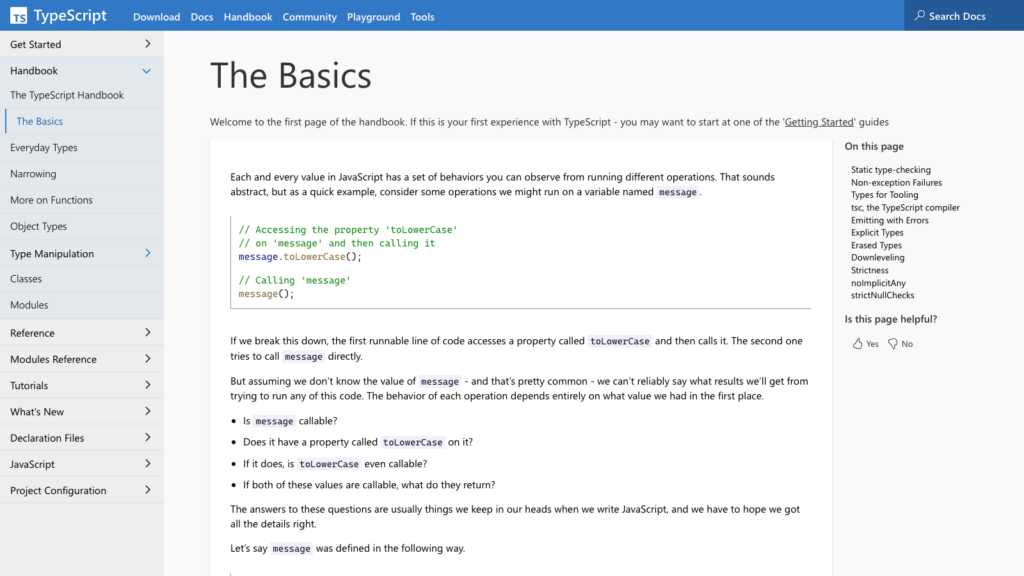
This is why TypeScript is more than a set of annotations. It is a shared vocabulary for the relationships inside a codebase. A type can tell a person what a function consumes, what it promises to return, which fields are optional, which states are possible, and which states should have been ruled out before reaching this branch.
Inference: You Do Not Have to Type Everything
One fear newcomers often have is that TypeScript asks them to annotate every line. In practice, good TypeScript relies heavily on inference.
When you write const greeting = "Hello", TypeScript can infer that greeting is a string. When a function maps a list of typed values, the result can often be inferred from the callback. When a library publishes declarations, your editor can follow types across an import without you restating every definition.
Inference is the part of TypeScript that makes the language feel less like bureaucracy and more like a conversation with a very attentive editor. You provide the important evidence; the tool carries it through nearby code.
Explicit annotations still have their place. Public function boundaries, exported data shapes, event payloads, and places where inference becomes too broad are good candidates. A useful rule is to annotate where a decision becomes part of the contract and let inference handle the local details.
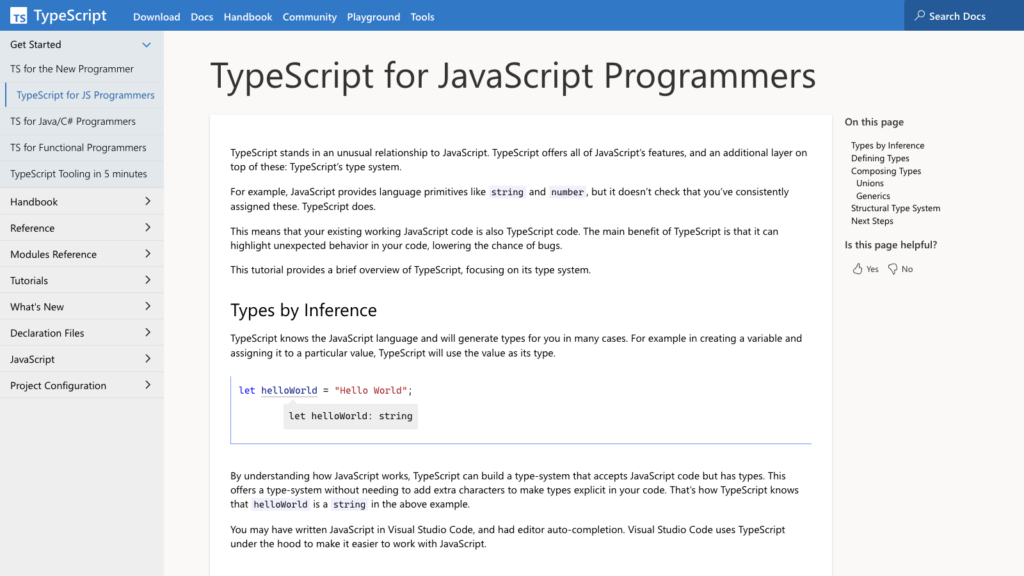
The official documentation uses this distinction to introduce JavaScript programmers to TypeScript. Existing JavaScript remains meaningful; TypeScript adds a layer that can infer and check more of its relationships. The goal is not to make every line ceremonious. It is to make important assumptions legible.
Structural Typing: Shape Matters More Than Names
TypeScript’s type system is structurally typed. In plain language, compatibility is usually based on what a value contains and can do, not only on the name of the type that produced it.
type Point = {
  x: number;
  y: number;
};

const location = { x: 10, y: 20, label: "home" };

function distanceFromOrigin(point: Point): number {
  return Math.sqrt(point.x ** 2 + point.y ** 2);
}

distanceFromOrigin(location);
The object called location has at least the properties required by Point, so it can be passed to the function. Its extra label property does not make it a different species of object for this use.
This is a natural fit for JavaScript, where objects are commonly assembled, extended, returned from libraries, and passed through several layers. It is also a source of occasional surprise for people coming from nominal type systems, where explicit declarations and names may carry more weight.
Structural typing is neither automatically safer nor automatically looser. It is a design choice. It makes composition pleasant, but it also means you need to think carefully about whether a shared shape really means a shared domain concept. Two objects can both contain id: string and still represent completely different things. Types describe relationships; they do not replace naming, architecture, or judgment.
Strict Mode Is a Team Decision
TypeScript becomes much more useful when the compiler is allowed to be honest. The strict compiler option enables a family of stronger checks, including rules around implicit any, null and undefined, function parameters, class properties, and related behavior. Individual checks can be adjusted, but turning strictness on is usually the clearest long-term starting point for a new project.

Strict mode is not a moral test. It is a feedback setting. On a new codebase, it creates a boundary from the beginning. On an old JavaScript codebase, enabling every check at once can produce a wall of errors that teaches the team very little. Migration sometimes needs a narrower first step, followed by a deliberate tightening of the rules.
The TypeScript documentation also warns that future versions may introduce additional checks under strict, which means an upgrade can expose new errors. That is not a reason to avoid strict mode. It is a reason to treat compiler upgrades like engineering changes: read the release notes, update deliberately, run the complete test suite, and decide whether a new diagnostic reveals a real weakness.
A practical configuration might begin like this:
{
  "compilerOptions": {
    "strict": true,
    "noEmit": true
  }
}
The exact settings depend on whether the project is an application, a library, a build package, or a mixed JavaScript migration. There is no prize for copying someone else’s tsconfig.json without understanding what the options do.
The Compiler Boundary: What TypeScript Can and Cannot See
TypeScript checks source code before it runs. It does not sit inside every running function and inspect every value arriving from the world.
Types are erased from ordinary JavaScript output. A type annotation does not become a runtime validator. An interface does not prevent a malicious request from sending an unexpected object. A union type does not guarantee that a database row still matches the same shape after a migration.
A type is a promise made inside the program. Data from outside the program still needs to be checked at the door.
This matters for security. TypeScript can make authentication logic easier to navigate and reduce some ordinary programming mistakes. It cannot sanitize HTML, verify a JSON payload, enforce authorization, validate a file upload, or protect a secret placed in a frontend bundle. Runtime validation and security controls remain necessary.
At an API boundary, a useful architecture separates two questions:
- Does the incoming value have the shape we accept? This is a runtime validation problem.
- How should the rest of the application use that accepted value? This is where static types can carry a trusted contract through the codebase.
Confusing those two questions is one of the fastest ways to create false confidence. TypeScript is a very good map. It is not a security guard.
Why Declaration Files Matter
TypeScript would be much less useful if it only understood code written in TypeScript. Its real reach comes partly from declaration files.
A .d.ts file describes types without containing the implementation that runs. It can tell the compiler what a JavaScript library exports, which arguments a function accepts, what a browser API returns, and which properties belong to a platform object. TypeScript ships declarations for standard JavaScript and browser APIs, while packages can bundle their own types or rely on the @types ecosystem.
This is one reason the language can be adopted without asking the entire ecosystem to be rewritten. A team can consume a JavaScript package through its declarations, add types around an internal module, or generate declarations when publishing a library. The type layer becomes a bridge between different histories of code.
It also creates maintenance work. A declaration can be incomplete, inaccurate, or out of sync with the runtime package. When the compiler says a library has a method, that information is only as trustworthy as the declaration behind it. Types improve communication, but they can also make a false description look official.
TypeScript in the Real Toolchain
TypeScript is not usually the application runtime. It is part of a larger path from source to execution.
A project may use the TypeScript compiler for checking and declaration generation while another tool handles bundling. A framework may compile TypeScript as part of its own development server. A test runner may transform files directly. An editor may use the TypeScript language service even when the production build uses a different transpiler.
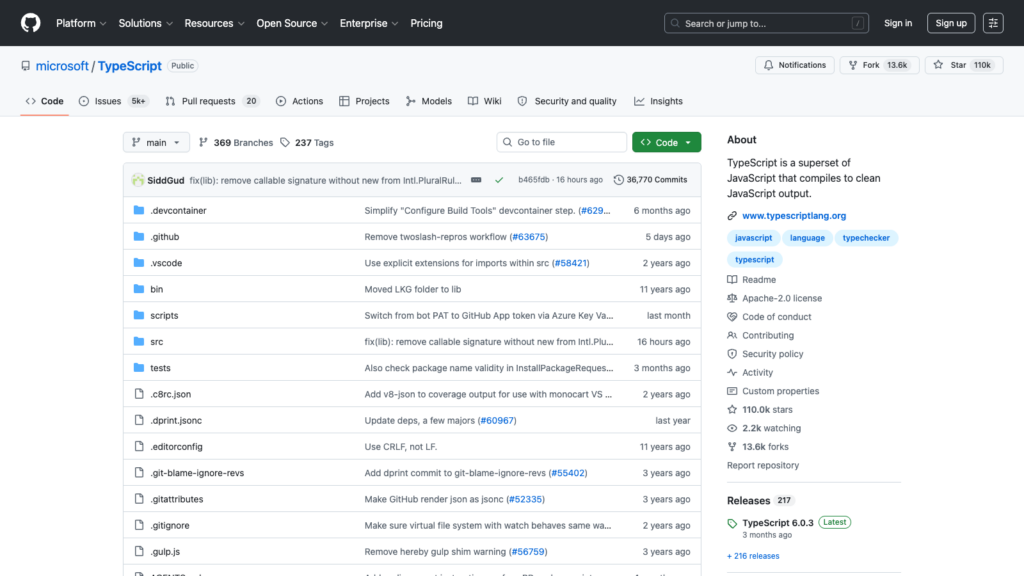
The official repository is useful here because it shows TypeScript as more than a file extension. It is a compiler, language service, project configuration system, declaration-file ecosystem, and open-source codebase. The moving parts are not all interchangeable, and a build can be fast while its type checking is disabled or incomplete.
That is why teams should ask what their build actually does. Does the fast development transform run type checking? Does CI run tsc --noEmit or an equivalent check? Are generated declaration files tested? Does the test environment resolve modules the same way as production? TypeScript can be present in a project while contributing less safety than its file extensions suggest.
For a small application, the simplest healthy pipeline is often enough:
npm install --save-dev typescript
npx tsc --init
npx tsc --noEmit
In a real project, the scripts, module settings, output target, and runtime environment need to be configured deliberately. The command is not magic. Its value comes from making the check part of the development and release habit.
How to Adopt TypeScript Without Making a Mess
Starting a new project is easy: choose a supported toolchain, create a tsconfig.json, enable the checks you understand, and keep the compiler in CI. The harder case is an existing JavaScript application with users, deadlines, and a pile of files that are all technically working.
Migration works best when it follows the application’s boundaries rather than the team’s enthusiasm. A useful sequence is:
- Make the current build visible. Record how JavaScript is transformed, tested, bundled, and deployed before adding another layer.
- Choose a meaningful boundary. A new feature, shared utility, API client, or domain module is often easier to type than the oldest file in the repository.
- Use inference first. Let the compiler learn obvious local values and spend explicit annotations on contracts.
- Replace vague escape hatches gradually. Treat
anyas a conscious boundary, not a universal translation of “I need the error gone.” - Type external data at the edge. Validate API, form, storage, and environment input before distributing it through the application.
- Raise strictness with evidence. Each new compiler check should produce a conversation about quality, not only a larger error count.
TypeScript supports JavaScript files too. Projects can use allowJs, JSDoc annotations, and generated declarations as transitional tools. A migration does not have to be a ceremonial rewrite in which the whole application stops so that every file can be renamed on the same afternoon.
The best migration is usually boring. A few more files become understandable, the compiler starts catching useful mistakes, and the team stops treating types as a separate project from the product.
Where TypeScript Helps Most
TypeScript earns its cost when the software has enough relationships that memory becomes unreliable.
- Shared domain models: Types make important entities and states visible across frontend, backend, and service layers.
- Large refactors: Renaming an exported field or changing a function contract can reveal much of the affected surface before users do.
- Team handoffs: A type can explain an interface to a developer who was not present when it was designed.
- Editor support: Completion, navigation, quick fixes, and inline diagnostics turn a large repository into something more searchable.
- Reusable libraries: Declaration files let consumers understand an API without reading its implementation first.
- State-heavy interfaces: Unions and narrowing can make impossible UI states harder to represent accidentally.
None of these benefits requires every type to be clever. The strongest types are often ordinary descriptions of things the business already cares about: an order can be pending, paid, refunded, or cancelled; a request can be authenticated or anonymous; a result can succeed or fail. Good types make domain decisions harder to ignore.
Where TypeScript Creates Friction
There is a temptation in technical writing to describe every tool as though its benefits arrive free. TypeScript has real costs.
The first is cognitive. Developers need to learn inference, narrowing, generics, unions, intersections, module resolution, declaration files, compiler options, and the difference between a type-level guarantee and a runtime fact. The language can remain approachable, but its advanced edge is not small.
The second is build complexity. A project may now have a compiler configuration, a bundler configuration, test transformations, generated output, and several tools that each understand slightly different parts of the module system. TypeScript does not cause every configuration problem, but it becomes another important participant in the chain.
The third is false certainty. A green type check can make a team feel safer while runtime inputs remain unvalidated. A perfect interface can describe the wrong business rule. An as assertion can silence the compiler without changing the value. The type system is powerful partly because it is limited; ignoring that limit turns power into theater.
There are also cases where plain JavaScript is the more economical choice. A short script, a disposable prototype, a tiny build tool, or a project whose team does not need a static layer may not benefit from TypeScript’s ceremony. It is possible to use a large tool because the industry says serious developers use it. That is not architecture. It is fashion with a package manager.
Performance, Security, Accessibility, and SEO
Performance
TypeScript’s type annotations are normally erased from emitted JavaScript, so choosing TypeScript does not automatically make a browser bundle faster or slower. The performance story comes from the surrounding toolchain, the emitted target, the bundler, the source maps, the libraries, and the code itself. A claim that “TypeScript is faster” needs a specific mechanism and a measured context.
Security
Static checking can reduce certain classes of programming mistakes, but it is not a security boundary. Validate untrusted input at runtime, authorize actions on the server, keep secrets out of client code, escape output according to its context, and use dependency and deployment controls appropriate to the system.
Accessibility and SEO
TypeScript does not make a page accessible or search-friendly by itself. It can make component props, accessibility-related data, and structured configuration easier to keep consistent, but semantic HTML, keyboard behavior, contrast, labels, server-rendered content, metadata, performance, and content quality remain implementation responsibilities.
This is an important pattern in modern development: a tool can support a quality goal without being the goal’s complete solution.
TypeScript Today: Version Numbers Need Context
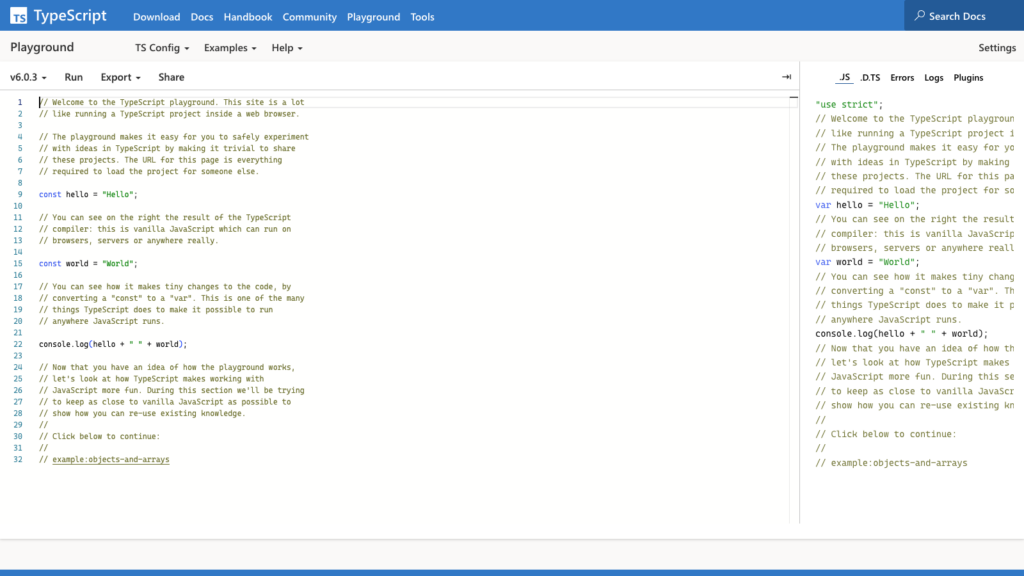
At the time of publication, the public npm registry reports TypeScript 7.0.2 as the latest package version. The official GitHub repository and the Playground are separate surfaces with their own release and integration timing; the Playground capture used here visibly offers compiler version 6.0.3. That difference is a useful reminder to verify the version actually installed in your project rather than copying a number from a screenshot or article.
In a real project, pin the version through your package manager and commit the lockfile. Read the official release notes before upgrading. Check compiler changes, declaration updates, module behavior, editor support, and the effect of stricter diagnostics. An upgrade is not just a number changing in package.json; it is a change to the language that reviews your code.
Should You Use TypeScript?
If you are starting a substantial web application, sharing types across several packages, maintaining a team-owned codebase, or publishing a library, TypeScript is usually worth serious consideration. Its value compounds with time. The first day may feel slower because you are naming relationships that JavaScript allowed you to leave implicit. The sixth month may feel faster because the repository has become less dependent on the memory of its original authors.
If you are writing a short script or exploring an idea, start with JavaScript if that keeps the idea moving. You can add types when the problem earns them. The right question is not whether TypeScript is professional enough. It is whether the project has enough shared assumptions that making those assumptions explicit will repay the effort.
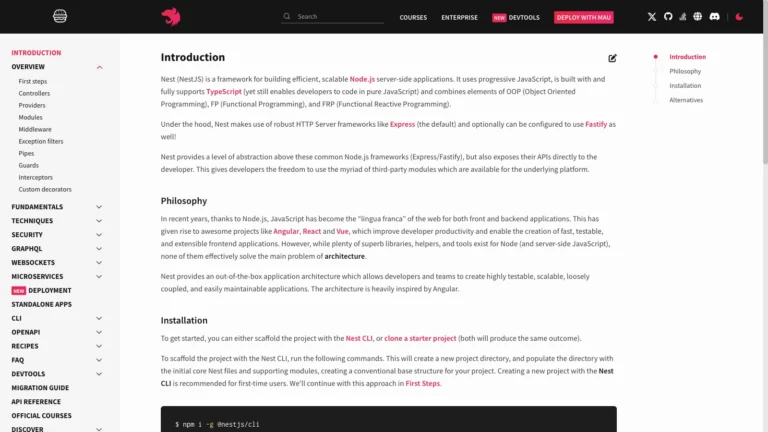
For readers already working with React, Next.js, or NestJS, TypeScript often feels like the connective tissue between application layers. It can describe a component’s inputs, a server route’s contract, a database-facing object, and a reusable package. But it should serve those boundaries rather than become a second language of abstraction layered on top of every small decision.
Use types to clarify. Use runtime validation to establish trust. Use tests to observe behavior. Use architecture to decide where responsibility belongs. No single tool should be asked to carry all four jobs.
The Future Is Maintenance, Not Magic
It is tempting to ask whether TypeScript will eventually make JavaScript obsolete, as though languages were contestants waiting for a final winner. The more durable story is less dramatic. JavaScript remains the execution environment and the enormous cultural center of the web. TypeScript is one of the strongest ways developers have found to make that environment more understandable at scale.
Its future will be shaped by the quality of its boundaries: how well it models JavaScript rather than denying it, how quickly the compiler and language service can keep up with large repositories, how honestly tools explain erased types and runtime gaps, and how willingly teams keep their declarations close to the behavior they describe. The most valuable evolution is not a new piece of syntax. It is a smaller distance between what the code says, what the tools believe, and what the program actually does.
Further Reading From Primary Sources
- The TypeScript Handbook
- The Basics
- Type Declarations
- The strict TSConfig option
- Official TypeScript releases
- The TypeScript Playground
The Quiet Value of a Type
There is something modest about a type. It is not a feature users see. It does not make a landing page more dramatic or a product demo more impressive. Most of the time, it is a small sentence placed beside a piece of code: this value has this shape; this function expects that relationship; this branch should not be possible.
Yet software is made from assumptions, and software breaks where assumptions drift apart. TypeScript gives a team a way to notice some of that drift while the work is still close enough to change.
That is not perfection. It is something more practical: a little less guessing, a little more shared language, and a codebase that can tell you when its own story has become inconsistent.
When the next project begins, the question is not whether every line should be typed. It is whether the future people responsible for the system deserve to know what the present team is assuming.