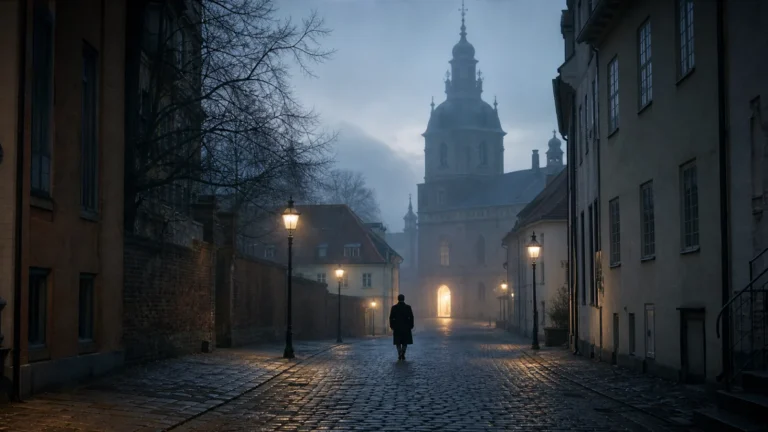
There are mornings when life feels completely ordinary until, without warning, the floor becomes philosophical.
You are washing a cup. Waiting for a message. Sitting in traffic. Opening the same laptop, in the same chair, with the same small reluctance in your body. Nothing dramatic has happened. No tragedy has announced itself. And yet the question arrives with a strange calmness.
Why?
Why this work, this worry, this wanting? Why all the plans, the grudges, the careful identities, the tiny victories we polish and keep close? Why love people who will die? Why build anything in a world that forgets so efficiently? Why continue, when the universe offers no final explanation for our continuing?
Most days we do not ask this directly. We are mercifully busy. Life protects itself with errands. We have emails, meals, appointments, bills, habits, half-finished conversations, and the small practical dignity of getting through the day. But sometimes the machinery pauses. The stage loses its paint. The familiar world becomes briefly strange.
Albert Camus begins there.
Not with a system. Not with a promise. Not with a doctrine that tells us the universe is secretly arranged for our comfort. He begins with a very plain wound: human beings long for meaning, and the world does not answer in the language we desire.
The absurd is not simply that life is hard. It is that we keep asking for ultimate meaning from a universe that remains silent.
This silence does not cancel our hunger. That is the difficult part. If we were merely meaningless creatures in a meaningless world, there would be no tragedy. A stone does not suffer because the mountain gives no explanation. A cloud does not feel betrayed by the sky. But we are not stones or clouds. We ask. We hope. We remember. We make promises. We bury our dead. We need our suffering to fit inside a story.
And sometimes, no story comes.
Camus calls this collision the absurd. It is not the universe alone that is absurd, nor the human longing alone. It is the meeting of the two: our need for clarity and the world’s refusal to become fully clear.
Once this is seen, really seen, a person cannot simply return unchanged. One can become distracted again, yes. One can pay rent, cook dinner, laugh, fall in love, read the news, and complain about the weather. Life resumes. But a small crack remains in the old innocence.
The question is what we do with that crack.
The Moment the World Becomes Strange
Camus was not interested in abstract despair. His absurdism is not an aesthetic of darkness. It is much more ordinary, and for that reason more disturbing. The absurd appears when daily life suddenly reveals its repetition.
Wake up. Commute. Work. Eat. Return. Sleep. Repeat.
For a while the rhythm carries us. There is comfort in rhythm. A person can live inside routine for years without asking too much of it. But then, one day, the question rises. Not as an intellectual hobby, but as a fatigue touched by amazement. Why am I doing this? Why does this matter? What is all this effort for?
The strange thing is that nothing has to go wrong for the question to appear. Sometimes it arrives in grief, but sometimes it arrives in success. Sometimes it comes after failure, but sometimes after getting exactly what we thought we wanted. The promotion, the apartment, the relationship, the recognition, the neat little evidence that one is becoming someone – and then, quietly, the heart asks whether this is enough.
This is why absurdism still feels modern. We live in a world full of explanations. Psychology explains us. Economics explains us. Biology explains us. Algorithms predict us. Productivity systems organize us. Social media displays us. And yet, beneath all this explanation, the deepest why remains strangely untouched.
We know more than ever, and still we do not know what to do with being alive.
I do not say this dramatically. It is not a complaint against knowledge. Knowledge is beautiful. To understand the mind, the body, history, language, or the stars is no small thing. But explanation is not the same as meaning. A mechanism can be described perfectly and still not tell us why the heart should consent to another day.
This is where Camus differs from many philosophers of meaning. He does not rush to heal the wound with metaphysics. He does not say that history has a guaranteed destination, or that suffering is secretly justified, or that God, progress, reason, nation, revolution, or personal destiny will make the whole thing add up in the end.
He asks whether we can live without that final addition.
The Hunger for Meaning
Human beings are meaning-making creatures. We cannot help it. We turn events into stories almost before we know we are doing it. A childhood becomes an origin myth. A breakup becomes a lesson. A failure becomes a sign. A coincidence becomes a hint from the universe if we are lonely enough to need it.
This is not foolish. It is deeply human. Meaning is one of the ways consciousness protects itself from chaos. To live completely without pattern would be unbearable. We need coherence. We need the world to feel familiar enough that we can walk through it without terror.
I think this is why absurdity frightens us. It does not merely say, “You will die.” We already know that, in theory. It says something colder: you may die without the universe having explained you to yourself.
All your loves, anxieties, humiliations, ambitions, and private little epiphanies may not be registered anywhere beyond the fragile circles of human memory. Your life may matter intensely to you and to those who love you, but not to the cosmos. The stars do not lean closer. Time does not pause. The sea continues.
And still, you care.
This is the ache. Not that life is meaningless in some cold mathematical sense, but that we are creatures who cannot stop needing meaning. The absurd is not an idea one merely understands. It is an experience one undergoes when the heart’s demand meets the world’s indifference.
In this sense Camus stands close to the problem I explored in Nietzsche’s confrontation with nihilism, but his temperament is different. Nietzsche wants transvaluation, height, danger, new values hammered out by stronger spirits. Camus is less intoxicated by greatness. He is more sunlit, more earthly, more attached to the warmth of human faces.
He does not want us to become gods.
He wants us to remain human without lying.
The First Temptation: To Leave the Question
The Myth of Sisyphus opens by facing a frightening question: whether life is worth living. Camus treats this not as a theatrical gesture, but as the most serious philosophical problem because every other question depends on being alive to ask it.
It is important to move carefully here. Camus is not romanticizing self-destruction. He is not making despair glamorous. He is asking why the discovery of meaninglessness should not lead someone to reject life itself. His answer is clear: to end one’s life is not to solve the absurd, but to remove one side of the confrontation.
The absurd exists only while the human being stands before the silent world and refuses to pretend the silence is speech. If the human being disappears, the tension disappears too. But disappearance is not an answer. It is an escape from the question.
For Camus, the dignity of the human being lies in staying with the contradiction. We want meaning, and we do not receive ultimate meaning. We want clarity, and the world remains partly opaque. We want permanence, and everything beloved is temporary. To live is to hold these facts without surrendering our capacity to love.
Absurdism begins when we refuse both despair and false comfort.
This refusal is not easy. There are days when the burden feels too heavy even in ordinary forms. A person need not be standing at the edge of a philosophical abyss to feel tired of being conscious. The world asks much from the living. But Camus’s response is not to deny the heaviness. It is to say that heaviness is not the whole truth.
Life may not be justified from above. Still, from within, it can be tasted, resisted, shared, touched, made.
The Second Temptation: To Invent an Answer Too Quickly
If physical escape is one temptation, metaphysical escape is another.
Camus calls this philosophical suicide. It happens when a person sees the absurd clearly, but then leaps into a belief system that dissolves the tension too conveniently. The leap can be religious. It can be ideological. It can be political. It can even be existentialist in style, if the self simply manufactures meaning and then treats its own creation as if it solved the cosmic silence.
This is a subtle point. Camus is not saying that all believers are fools, or that all commitments are dishonest. He is suspicious of the moment when thought reaches a limit and then smuggles in certainty because uncertainty is unbearable.
We know this temptation intimately. It is not confined to churches or political movements. It appears anywhere a person wants relief more than truth.
- We join a tribe because loneliness hurts.
- We adopt an ideology because ambiguity is tiring.
- We call our preferences principles because it feels nobler.
- We treat productivity as salvation because stillness frightens us.
- We make identity into armor because being open is too exposed.
In each case, the mind is tempted to close the question too soon.
This is why Camus’s honesty matters. He does not allow us to use philosophy as a sleeping pill. He wants thought to remain faithful to the condition that awakened it. If the absurd begins in the collision between hunger and silence, then any solution that denies the hunger or pretends the silence has spoken too clearly has already stepped away from the problem.
There is an integrity in not knowing.
Not the lazy kind of not knowing that refuses to think. A different kind: lucid not knowing, disciplined not knowing, the kind that will not invent a heaven merely because the desert is uncomfortable.
The Third Way: Revolt Without Consolation
So what remains?
For Camus, the answer is revolt. Not revolt as noise. Not revolt as adolescent refusal. Not revolt as the romance of being against everything. Revolt, in Camus, is the steady refusal to let meaninglessness have the final emotional word.
The absurd person does not escape into death. He does not escape into false certainty. He remains awake. He sees the limits. He sees that the universe offers no final guarantee. He sees that every project is temporary, every love vulnerable, every achievement destined to fade. And then he lives anyway.
This “anyway” is the heart of absurdism.
It is not optimism. Optimism often depends on expectation: things will improve, history will vindicate us, the story will turn out well. Camus gives us something harder and cleaner. He gives us fidelity without guarantee. Action without metaphysical insurance. Joy without the demand that joy become eternal before it counts.
To live absurdly is to live without appeal. No final court. No hidden accountant adding up our pain and reward. No cosmic parent quietly ensuring that all losses will be restored. And yet this does not lead Camus to a bitter philosophy. Strangely, it leads him toward sunlight, friendship, the body, the sea, the present moment, and the stubborn beauty of human solidarity.
Callout: The absence of ultimate meaning does not make bread less warm, music less real, friendship less necessary, or grief less worthy of tenderness.
This is where many misunderstand absurdism. They hear “life has no ultimate meaning” and assume the next sentence must be “therefore nothing matters.” Camus moves differently. Because there is no final meaning imposed from outside, the immediate world becomes more vivid, not less. The hand, the face, the morning light, the shared table, the person beside us – these do not need eternity in order to matter.
Maybe they matter precisely because they do not last.
Sisyphus and the Shape of Our Days
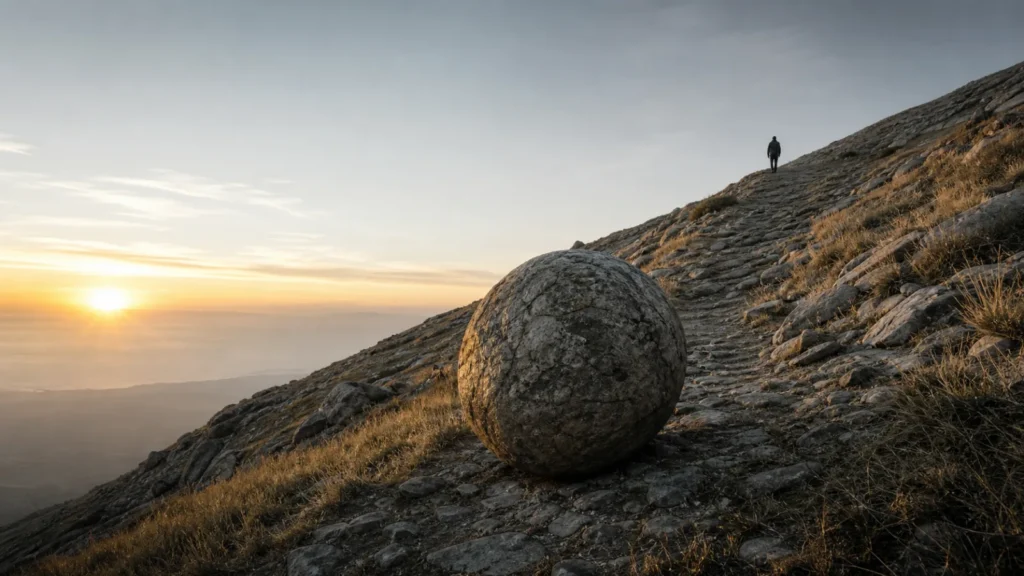
Camus found his great symbol in Sisyphus, the figure from Greek myth condemned by the gods to roll a stone up a mountain forever, only to watch it fall back down each time.
It is not difficult to see why this image has lasted. The punishment is almost too clear. Work without completion. Effort without final result. Repetition without progress. A task that can never be finished, and therefore can never justify itself by ending.
But this is not only an ancient myth. It is embarrassingly modern.
We answer messages that will be replaced by more messages. We clean rooms that will become messy again. We solve problems that create new problems. We raise children who will suffer despite our love. We maintain bodies that are already aging. We build careers inside economies that forget us quickly. We create, repair, repeat.
The stone changes shape, but everyone has one.
Camus’s genius is not simply that he sees the futility. Many people see futility. Cynicism sees futility and becomes proud of noticing. Despair sees futility and collapses. Camus sees futility and asks whether consciousness can transform the relation to it.
Sisyphus is most interesting not while he pushes the stone, but while he walks back down the mountain. During the descent, he knows everything. He knows the stone has fallen. He knows the labor will begin again. He knows there will be no final success. Yet in that awareness, Camus finds a strange victory.
The gods can command the task. They cannot command his inner consent.
His punishment becomes his domain. His fate becomes something he sees clearly, and in seeing it clearly, he is no longer merely its victim. The mountain is still there. The stone is still heavy. But illusion has been removed, and with it a certain kind of slavery.
There is a freedom that begins only after we stop demanding that life become other than it is before we agree to live it.
The Difference Between Nihilism and Absurdism
Absurdism is often mistaken for nihilism, but the difference is crucial.
Nihilism takes the absence of ultimate meaning as a conclusion. It says: nothing matters. Absurdism takes the absence of ultimate meaning as a starting point. It says: now what kind of life can we live honestly?
This difference may look small in theory, but in life it is enormous.
Nihilism often hardens the heart. Absurdism keeps the heart exposed. Nihilism can become a form of superiority, a way of standing above the world because one has seen through it. Absurdism refuses that cold elevation. It remains in the world. It accepts coffee, friendship, bodies, laughter, work, desire, grief, summer, and the ordinary tenderness of being temporary with other temporary beings.
Camus is not interested in clever detachment. He is interested in lucid attachment. He wants us to love the world without needing it to be metaphysically innocent.
This is harder than cynicism. Cynicism often protects itself by refusing to be moved. Absurdism permits itself to be moved while knowing that nothing is guaranteed. It is a more vulnerable philosophy than it first appears.
To say yes to life because one believes everything will be redeemed is one thing. To say yes while knowing that redemption may not come in any ultimate sense is another. This second yes is quieter, but perhaps more courageous.
What Absurdism Looks Like in Ordinary Life
It is tempting to leave Camus on the mountain with Sisyphus, where everything is grand and symbolic. But the real question is much more practical: what does absurdism look like on a Tuesday?
Not in a book. Not in a myth. In a kitchen, a hospital corridor, a lonely apartment, a crowded bus, a meeting that could have been an email, a marriage trying to survive disappointment, a body that does not work the way it used to.
I think it begins with refusing theatrical answers.
- Do the work, but do not worship the work.
- Love people, but do not pretend love protects anyone from loss.
- Seek clarity, but do not force the world to become simpler than it is.
- Enjoy pleasure, but do not ask pleasure to become salvation.
- Tell the truth, especially when the truth gives you no advantage.
Absurdism is not a mood. It is a discipline of lucidity. It asks us to keep our eyes open without letting openness become paralysis.
This is where it meets the ordinary structure of habit. I have written elsewhere about the architecture of habit, and Camus helps me see another dimension of it. Habits are not merely efficiency tools. They are ways of answering existence. The way we wake, work, speak, eat, walk, forgive, and return to our stone each morning reveals what we have decided life deserves from us.
One does not need a grand metaphysical system to live with dignity. Sometimes dignity is smaller. Keeping a promise. Making soup. Refusing cruelty. Walking in sunlight. Beginning again without pretending the previous effort was permanent.
There is something almost tender in this. Camus does not save us from repetition. He teaches us to inhabit repetition without becoming spiritually dead.
Human Relations as the First Luxury
What, then, does Camus offer in place of ultimate meaning?
Not a grand theory. Not a new religion. Not a heroic cult of the self. He brings us back to something touchable: human relations.
This is one of the most beautiful turns in his thought. The absurd begins in loneliness, because the person who sees it feels separated from the familiar world. But rebellion, once it begins, discovers others. My suffering is mine, yes, but it is not mine alone. The strangeness I feel belongs to the human condition. The distance between our longing and the universe is shared.
This changes everything.
If I suffer alone, the absurd can become a private prison. If I understand that suffering is shared, revolt becomes solidarity. The first value is no longer an abstract principle but the presence of another human being who is also fragile, also confused, also temporary, also trying to live without a final guarantee.
Camus’s humanism is not sentimental. He knows people can be cruel, vain, cowardly, ridiculous, and dangerous. But he also knows that without one another, lucidity becomes unbearable. A world without ultimate meaning does not make human relations less important. It makes them more immediate.
In a universe that does not answer, we become answerable to one another.
That line, for me, comes close to the moral center of Camus.
We do not need to prove the universe loves us in order to practice tenderness. We do not need eternity in order to be faithful for today. We do not need a cosmic witness in order to refuse humiliation, domination, and unnecessary suffering. If anything, the absence of a final judge leaves the responsibility more nakedly in our hands.
Lucidity Without Cruelty
There is a danger in philosophies of lucidity. They can become hard. A person can take pride in seeing through illusions and slowly lose the ability to love what remains.
Camus resists this more than many modern thinkers. His clarity is not cold. He does not confuse honesty with contempt. He does not think that because life lacks final meaning, human pain becomes trivial. On the contrary, pain becomes more urgent because this life is the one we have.
This is where absurdism touches ethics. If there is no divine script guaranteeing justice, then justice becomes a human task. If no final reconciliation is promised, then reconciliation here matters. If there is no metaphysical rescue waiting beyond the world, then the world deserves more care, not less.
Lucidity should make us gentler, not crueler.
Or perhaps not gentler in the soft sense. Camus can be firm. Revolt has backbone. But the firmness is against falsehood, humiliation, and despair, not against the vulnerable fact of being human.
This matters especially now. We live in a time where people often mistake exposure for wisdom. To expose someone’s motive, to reveal the hidden interest, to reduce the beautiful thing to its biological, economic, or psychological explanation – this can feel like intelligence. Sometimes it is intelligence. But it can also become a cheap form of mastery.
As I wrote in Thinking About Thinking, awareness of the mind’s machinery does not automatically make us wise. It may simply give us more sophisticated ways to avoid humility. Camus asks for another kind of intelligence: one that sees clearly and still refuses to despise.
Joy in the Desert
One of the surprises in Camus is joy.
If someone described absurdism in outline, we might expect a bleak philosophy. Death is certain. Meaning is not guaranteed. The universe is silent. Our labor repeats. Our loves are temporary. Fine. What remains but resignation?
But Camus keeps returning to the senses. Sun on skin. The sea. The body in motion. Friendship. Desire. The present hour. The immediate world that can be touched with the hand.
This is not distraction from the absurd. It is part of the response. To live without appeal is not to become abstract. It is to become more faithful to what is near.
We often search for meaning as if it must be hidden somewhere above life, behind life, after life. Camus gently brings the eye back down. Perhaps meaning is not a secret stored in another realm. Perhaps what we call meaning often begins as attention: to bread, weather, faces, work, injustice, laughter, the absurd beauty of still being here.
Does this solve the metaphysical problem? No.
That is precisely the point.
Camus is not solving the absurd. He is asking whether it must be solved before life can be loved. His answer is no. The stone will fall again. The body will fail. History will disappoint. People will misunderstand us. Everything we make will one day be dust or data or nothing at all.
And still there is morning.
Still there is the possibility of speaking honestly, of making something modest and real, of refusing unnecessary cruelty, of laughing with someone in the middle of the unfinished world.
The Burden We Find Again
Camus ends with Sisyphus returning to his stone. This is important. The story does not end with escape. There is no divine pardon, no clever trick, no final victory in the ordinary sense. One always finds the burden again.
But perhaps freedom is not the absence of burden. Perhaps freedom begins in the way we meet what cannot be removed.
This is not a message I would want to make too neat. Some burdens are unjust and should be fought politically, socially, personally. Camus’s absurdism should not be used to tell people to accept oppression with a poetic smile. Revolt matters. Resistance matters. The stone is not always noble. Sometimes it is placed there by cruelty, and then the task is not only to push but to change the conditions that keep crushing people.
Still, every life contains burdens that cannot be abolished. Mortality. Loss. Repetition. Uncertainty. The fact that no one else can fully live our life for us. The fact that love does not protect us from grief but makes grief possible.
Camus helps us meet these without kneeling before despair.
He does not ask us to pretend the mountain is easy. He does not ask us to believe the stone will one day stay at the summit. He asks whether the struggle itself, seen clearly and embraced without illusion, can be enough to fill a human heart.
I do not know if I always believe that.
But I know there are days when I want to.
And maybe wanting to is already part of the revolt.
To Live Without Final Permission
What I find most enduring in Camus is not a doctrine but a posture.
Stand in the world without lying about it. Refuse despair because despair also claims too much. Refuse false consolation because consolation bought at the price of honesty is too expensive. Love what is mortal. Work without guarantees. Create in the desert. Find others. Begin again.
This is not heroic in the loud sense. It is almost quiet enough to miss. A person gets up. A person returns to the task. A person does not pretend the task is eternal. A person does not deny the ache. A person sees the absurdity and still makes coffee, calls a friend, writes a sentence, repairs what can be repaired, resists what must be resisted.
Perhaps this is why Sisyphus can be imagined as happy. Not because his punishment has become pleasant. Not because the gods were secretly kind. Not because the stone is light. But because he has stopped asking the gods to grant him the meaning of his own defiance.
The mountain is his. The stone is his. The descent is his. The clear mind is his.
And for a human being, perhaps that is already a great deal.
There is no need to make the ending grand. Camus would probably distrust that. The absurd does not vanish because we have spoken beautifully about it. Tomorrow will still ask its ordinary price. The stone will be waiting in some familiar form.
But maybe the question is not whether we can escape the stone.
Maybe the question is whether, knowing it will fall again, we can still place our hands on it without hatred for the world.