World War II is often taught as a line of dates. 1939. 1941. 1942. 1944. 1945. Poland, Pearl Harbor, Midway, Stalingrad, Normandy, Berlin, Hiroshima, Tokyo Bay. We arrange the years neatly because the mind needs order, especially when the subject itself is almost too large to hold.
But dates are not only markers. They are doors.
Behind each date there is a room somewhere: a cabinet meeting, a cockpit, a railway platform, a field hospital, a bridge, a kitchen where the radio has gone quiet, a ship’s deck before dawn, a ruined street where someone is looking for water. History becomes easier to remember when we turn it into a timeline. It becomes harder, and more honest, when we remember that each point on the line was lived by people who did not yet know what the next point would be.
The Second World War lasted, in the usual reckoning, from Germany’s invasion of Poland on 1 September 1939 to Japan’s formal surrender on 2 September 1945. Six years and one day. Yet even that clean boundary needs care. In Asia, full-scale war between Japan and China had already begun in 1937. In Europe, the crises of the 1930s had been warning signs written in plain sight. The war did not fall from the sky fully formed. It gathered.
What follows is not a museum label stretched into prose. It is a way of walking through the war by dates, while trying not to lose the human weight of them. Twenty moments cannot contain the whole conflict. No timeline can. But some dates act like hinges: after them, the world opened differently.
A timeline tells us what came next. History asks why it mattered, who paid for it, and what kind of world was left behind.
Why the War Happened Cannot Fit in One Cause
It is tempting to say that World War II happened because Hitler invaded Poland. As a beginning date for the European war, that is true. As an explanation, it is too small. Wars of this scale do not emerge from a single morning, even when a single morning makes them official.
The world after the First World War was full of unresolved anger. The Treaty of Versailles punished Germany and redrew parts of Europe, but it did not create a stable peace. New states emerged. Old empires had collapsed. Borderlands were contested. National humiliation became political fuel. Economic crises, especially the Great Depression, weakened democratic confidence and made radical promises sound less impossible to frightened societies.
In Germany, Hitler and the Nazi movement turned grievance into ideology and ideology into state power. Their vision was not merely nationalist pride. It was racial empire: the destruction of Jews, the crushing of political enemies, the conquest of eastern Europe, the enslavement and removal of peoples considered inferior, and the creation of a continental order built on violence. Rearmament, the remilitarization of the Rhineland, the annexation of Austria, the destruction of Czechoslovakia’s independence – each step tested the will of other powers.
Appeasement is now an easy word to condemn, and in many ways condemnation is justified. Yet historical judgment should still remember the atmosphere of the 1930s. Britain and France had memories of the First World War so deep they were almost physical. Their publics feared another slaughter. Their militaries were not always ready. Their leaders hoped that concessions might contain Hitler’s ambitions or buy time. The tragedy is that buying time can also teach an aggressor that time is his ally.
In Italy, Mussolini’s Fascist regime pursued empire and prestige, invading Ethiopia in 1935 and binding itself more tightly to Nazi Germany. In Japan, militarism, imperial ambition, resource hunger, and the search for regional dominance drove expansion across East Asia. The war in China was not a side story; it was one of the major human catastrophes of the century and a central part of the road to the wider Pacific War.
Then there was Stalin’s Soviet Union, itself a brutal dictatorship, entering a temporary pact with Hitler in 1939 for reasons of security, opportunity, and calculation. The Nazi-Soviet Pact shocked the world, but it made practical sense to both regimes in the short term. It cleared Hitler’s way into Poland and gave Stalin territory and time. For the people of Poland and the Baltic states, those calculations were not abstractions. They became arrests, deportations, occupation, and fear.
So if we ask why World War II happened, the answer is not one cause but a convergence: failed peace, economic despair, fascist and militarist expansion, imperial competition, racial ideology, democratic hesitation, authoritarian ambition, and the repeated failure to stop aggression before it gathered enough force to become world war.
History rarely gives us a single locked door. More often, it gives us many doors left open too long.
Before September: The War Already Burning in Asia
Any honest World War II timeline has to begin before Europe formally enters the war. On 7 July 1937, a clash near the Marco Polo Bridge outside Beijing became the opening of full-scale war between Japan and China. It was not the first Japanese move on the Asian mainland; Japan had already seized Manchuria in 1931. But the Marco Polo Bridge Incident widened the conflict into a devastating Sino-Japanese War that lasted until 1945.
This matters because “World War II” can look different depending on where one stands. From London, Paris, or Warsaw, 1939 is the obvious beginning. From China, the catastrophe had already been unfolding for years. Beijing fell in July 1937. Shanghai and Nanjing became names of brutal urban war and atrocity. Japan’s war in China weakened both the Chinese Nationalist government and Japan itself, drawing the region deeper into a struggle that would later merge with the Pacific War.
There is a temptation, when telling global history, to let Europe become the center by habit. But the war was not only Europe with Asia added later. It was a set of crises – imperial, ideological, economic, racial, military – that eventually joined into one world conflict. The map did not catch fire in a single place.
Still, September 1939 remains the decisive European threshold. It was the moment when appeasement, threats, guarantees, secret agreements, and illusions ran out of room.
1939-1940: Europe Enters the War
1 September 1939: Germany Invades Poland
At dawn on 1 September 1939, German forces crossed into Poland. The invasion combined air power, armored movement, infantry, and terror against civilians. Poland fought, but it faced a stronger military machine and a terrible strategic position. Britain and France, bound by guarantees to Poland, declared war on Germany on 3 September. Yet they could not save Poland from being crushed.
On 17 September, the Soviet Union invaded eastern Poland under the terms of the secret protocol attached to the Nazi-Soviet Pact of August 1939. Poland was partitioned between two predatory powers. Warsaw surrendered near the end of September, and organized resistance on Polish soil was broken soon after, though the Polish state and military struggle continued in exile and underground.
For Poland, the war did not mean only military defeat. It meant occupation, mass murder, forced deportation, the destruction of Jewish life, political terror, and a national wound that would remain open long after 1945. The German occupation became genocidal. Soviet rule in the east brought its own arrests, deportations, and killings, including the massacre of Polish officers and others at Katyn in 1940.
Thus the European war began not simply as a clash of armies, but as a warning of what occupation would mean in the twentieth century: not only flags changed over buildings, but entire categories of people marked for removal, enslavement, or death.
10 May 1940: Germany Attacks Western Europe
After Poland fell, a strange waiting period settled over western Europe. The war existed, but the main armies did not yet fully collide. Then, on 10 May 1940, Germany attacked the Netherlands, Belgium, Luxembourg, and France. The offensive bypassed expectations, used speed and surprise, and shattered confidence in the old military order.
The German breakthrough through the Ardennes and the drive toward the Channel cut Allied forces apart. British and Allied troops were evacuated from Dunkirk in late May and early June, a rescue that saved men but not the campaign. France signed an armistice on 22 June 1940. Much of northern and western France came under German occupation, while a collaborationist regime was established at Vichy in the south.
The fall of France transformed the war. Britain was left facing Germany without a major continental ally in the west. Hitler’s confidence soared. The idea that Germany might dominate Europe no longer felt like rhetoric. It had become geography.
10 July-31 October 1940: The Battle of Britain
For an invasion of Britain to be possible, Germany needed air superiority. The Battle of Britain was therefore not merely an air campaign; it was a test of whether the war would cross the Channel in force. The Luftwaffe attacked shipping, airfields, radar installations, and later cities. RAF Fighter Command, supported by radar, ground crews, aircraft production, and pilots from Britain, the Commonwealth, and occupied Europe, held on.
Its significance is easy to state and hard to feel. Britain did not defeat Germany in 1940. But it refused to be removed from the war. That refusal mattered enormously. It preserved a base for future operations, kept a western enemy alive against Hitler, and gave time for the conflict to widen in ways Germany could not fully control.
7 September 1940-May 1941: The Blitz
When German bombing shifted heavily toward London and other British cities, the war entered night after night of civilian terror. The Blitz killed more than 40,000 civilians and damaged homes, docks, factories, churches, shops, streets, and neighborhoods. Coventry, Liverpool, London, Birmingham, Plymouth, and many other places endured destruction from the air.
Strategic bombing raised questions that would follow the war all the way to Dresden, Tokyo, Hiroshima, and Nagasaki. How much civilian suffering could be justified by military purpose? Could bombing break morale, or did it harden it? What happens to moral language when war moves from the battlefield into the bedroom and the shelter?
Britain’s capacity to continue the war survived. But survival should not be made too tidy. The Blitz was not only resilience under fire. It was grief under fire. It was the discovery that modern war could make civilians permanent participants without asking them first.
1941: The War Becomes Global
22 June 1941: Operation Barbarossa
On 22 June 1941, Germany and its Axis partners invaded the Soviet Union. Operation Barbarossa was the largest land invasion in history, driven by ideology, conquest, resources, racial fantasy, and Hitler’s long-standing obsession with destroying Bolshevism and seizing living space in the east.
At first, the German advance was staggering. Soviet forces suffered catastrophic losses. Huge numbers of prisoners were taken. Cities and regions fell. The siege of Leningrad began. German forces drove toward Moscow and deep into Ukraine. But the Soviet Union did not collapse. Its territory, population, industrial relocation, state violence, patriotic mobilization, and sheer endurance changed the scale of the war.
The Eastern Front became the central furnace of the European war. It was there that the majority of German military losses would occur, and there that the Nazi project revealed with particular clarity its genocidal character. The invasion of the Soviet Union was not a conventional campaign alone. It was a war of annihilation, accompanied by mass shootings, starvation policies, anti-Jewish violence, and the brutal treatment of Soviet prisoners of war.
When the Red Army counterattacked outside Moscow in December 1941, it did not end the threat. But it destroyed the myth that Germany could simply knock the Soviet Union out in one campaign season. Winter, distance, resistance, and overreach began to do their work.
7 December 1941: Pearl Harbor
On 7 December 1941, Japanese aircraft attacked the United States Pacific Fleet at Pearl Harbor in Hawaii. The strike damaged or sank battleships and killed more than 2,400 Americans. It was a tactical shock and a political transformation. The next day, the United States declared war on Japan. On 11 December, Germany and Italy declared war on the United States.
With that, the war became truly global. The United States, already supporting Britain and other Allies materially, entered as a belligerent. Japan’s simultaneous campaigns across Southeast Asia and the Pacific threatened British, Dutch, American, and other colonial possessions. Hong Kong, Malaya, the Philippines, the Dutch East Indies, and Burma were drawn into the storm.
Pearl Harbor is often remembered as a sudden beginning. In American memory, it was. But in Asian memory, it also joined an older war already raging in China and a wider Japanese imperial project already in motion. Again the timeline depends on where one is standing.
15 February 1942: The Fall of Singapore
Singapore surrendered to Japanese forces on 15 February 1942 after the rapid invasion of Malaya and the collapse of British defenses. The defeat was military, imperial, and psychological. More than 100,000 British and Commonwealth troops went into captivity. The myth of European invincibility in Asia suffered a blow from which it never fully recovered.
This matters beyond the battlefield. Empires depend not only on force but on aura. Singapore showed that aura could shatter. Across Asia, the defeat altered how colonized peoples imagined European power. Japan’s own occupation would become harsh and exploitative, but the old imperial order had been visibly wounded.
1942-1943: The Axis Advance Breaks
4-7 June 1942: Midway
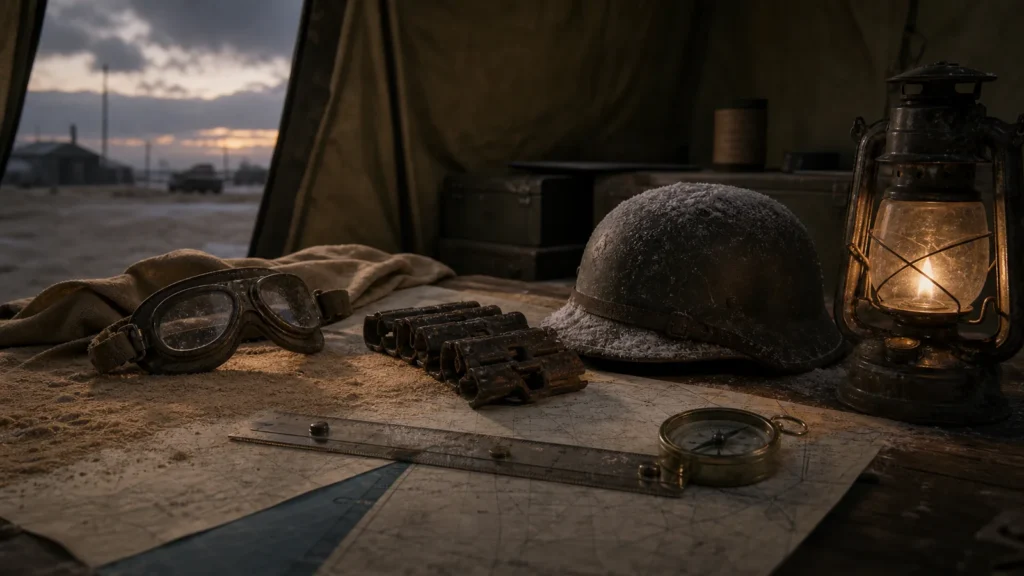
Six months after Pearl Harbor, Japan still held the initiative across much of the Pacific. At Midway, Japanese planners hoped to lure out and destroy the remaining American aircraft carriers. Instead, American codebreaking gave Admiral Chester Nimitz crucial knowledge of the plan. The battle that followed cost Japan four fleet carriers and many experienced aircrew.
Midway did not end the Pacific War. Nothing so vast ends so quickly. But it changed the direction of initiative. Japan could still fight fiercely, and would, for years. Yet its ability to expand unchecked had been broken. In the Pacific, a war of conquest began to become a war of attrition that Japan was poorly placed to win.
23 October-4 November 1942: El Alamein
In North Africa, Axis forces under Erwin Rommel had threatened Egypt and the Suez Canal. At El Alamein, the British Eighth Army under Bernard Montgomery launched an offensive after careful buildup of men, armor, artillery, and supplies. The result was an Allied victory that forced Axis retreat westward across Libya.
El Alamein mattered strategically because it checked Axis hopes in Egypt and protected the route through the Suez. It mattered emotionally because Britain needed a land victory after years of anxiety, reverses, and defensive endurance. It gave the British public a sense that the war’s direction could change.
But North Africa was not won in one battle. Operation Torch, the Anglo-American landings in Morocco and Algeria in November 1942, squeezed Axis forces from the west. The campaign ended in May 1943 with the Axis surrender in Tunisia. The Mediterranean began to open toward Italy.
August 1942-2 February 1943: Stalingrad
Stalingrad was both a military struggle and a symbolic ordeal. German forces reached the city in late summer 1942. The fighting became a terrible urban battle in factories, cellars, streets, stairwells, and ruins. Soviet defenders under Vasily Chuikov held on while Georgy Zhukov and Soviet planners prepared the counteroffensive that would trap the German Sixth Army.
On 19 November 1942, Soviet forces launched Operation Uranus, striking the weaker Axis flanks north and south of the city. The encirclement closed. Hitler ordered the Sixth Army to hold out, and attempts to relieve it failed. German surrender came in stages at the end of January and on 2 February 1943.
Stalingrad became one of the decisive turning points of the war, but that phrase can become too smooth. Behind it were hunger, frost, bombardment, civilian death, military stubbornness, ideological hatred, and a city reduced almost beyond recognition. I have written more fully about this in Stalingrad and the City That Would Not Fall, because Stalingrad deserves more than a line on a timeline.
5 July 1943: Kursk
After Stalingrad, Germany tried to regain the initiative on the Eastern Front. The Battle of Kursk began in July 1943 as a massive German offensive against a Soviet salient. The Soviets had prepared deep defensive belts, minefields, anti-tank positions, and reserves. The German attack made only limited gains at heavy cost.
Kursk mattered because it marked the last major German strategic offensive in the east. Afterward, the Red Army increasingly drove the rhythm of the war. The German army remained dangerous, but the direction had changed. The long road west had begun.
1944-1945: Liberation, Collapse, and Moral Reckoning
6 June 1944: D-Day
Operation Overlord began on 6 June 1944, when Allied forces landed on the beaches of Normandy. British, American, Canadian, and other Allied troops came ashore under the command of General Dwight D. Eisenhower, supported by naval and air power. Airborne troops landed behind the beaches. By the end of the day, the Allies had established a foothold in France, though at terrible cost in places such as Omaha Beach.
D-Day did not instantly liberate Europe. The Normandy campaign was slow, brutal, and costly. The bocage terrain favored defense. German resistance stiffened. Yet the landings opened the long-awaited western front. Paris was liberated in August. Allied armies moved toward Germany, while the Soviet Union pressed from the east.
23-26 October 1944: Leyte Gulf
In the Pacific, the Battle of Leyte Gulf took place as American forces returned to the Philippines. It was one of the largest naval battles in history, actually a series of engagements across a vast area. Japan attempted a complex plan to disrupt the landings, using remaining naval strength in a desperate gamble.
The battle ended with devastating Japanese losses, including carriers, battleships, cruisers, aircraft, and the effective destruction of Japan’s ability to conduct large-scale fleet operations. The Pacific War would continue with horrific intensity, but Japan’s naval position had become increasingly hopeless.
4-11 February 1945: Yalta
At Yalta in Crimea, Franklin Roosevelt, Winston Churchill, and Joseph Stalin met to discuss the final phase of the war and the shape of the postwar order. Germany’s division, war crimes trials, the future United Nations, Soviet entry into the war against Japan, and eastern Europe all stood in the room, though not all were equally negotiable.
Yalta has often been remembered through the bitterness of what followed. The Red Army already occupied much of eastern Europe, and Stalin held realities on the ground that the western Allies could not easily reverse. The conference did not create the Cold War by itself, but it revealed many of the tensions from which the Cold War would grow.
13-15 February 1945: Dresden
The bombing of Dresden remains one of the war’s most controversial Allied actions. In February 1945, RAF and USAAF bombers attacked the city, creating a firestorm and killing tens of thousands. Dresden had military and communications significance, but the scale of civilian death and the timing, so late in the war, have made the raid a lasting moral question.
It is possible to understand the logic of strategic bombing in 1945 and still feel the horror of what it did. War does not become clean because the cause is just. The Allied cause against Nazism was necessary. Some Allied actions still demand moral seriousness. Holding both truths is not weakness. It is the beginning of historical maturity.
15 April 1945: Bergen-Belsen Liberated
British forces liberated Bergen-Belsen concentration camp on 15 April 1945. What they found shocked even soldiers hardened by war: tens of thousands of prisoners, many seriously ill, amid catastrophic conditions. Newsreel footage, photographs, and broadcasts forced British and wider Allied publics to confront the physical reality of Nazi crimes in a way reports alone had not done.
Bergen-Belsen was not an extermination camp like Auschwitz-Birkenau, but by 1945 its overcrowding, starvation, disease, and neglect had made it a place of mass death. Its liberation stands in any timeline not because it was the beginning of knowledge about the Holocaust, but because it became one of the moments when denial became harder for ordinary people far from the camps.
The Holocaust cannot be placed neatly inside a military timeline, as if genocide were one event among battles. It was a central part of Nazi rule and war, evolving from persecution and exclusion into mass murder. Nearly six million Jews were murdered by Nazi Germany and its collaborators, alongside millions of other victims targeted by Nazi racial, political, and social policies. To speak of World War II without this is to speak of the war with its moral center missing.
8 May 1945: Victory in Europe
Germany’s unconditional surrender took effect on 8 May 1945 in much of Europe, remembered as VE Day. In the Soviet Union, because of time zones and the Berlin signing, victory was marked on 9 May. Berlin had fallen. Hitler was dead. The Nazi state was collapsing into occupation, ruin, and judgment.
There were celebrations, and understandably so. But VE Day was not simple joy. Millions were dead. Cities were destroyed. Survivors of camps, forced labor, occupation, bombardment, and displacement faced the question of how to live afterward. For Allied soldiers and civilians with loved ones still fighting Japan, the war was not yet over.
6 and 9 August 1945: Hiroshima and Nagasaki
On 6 August 1945, the United States dropped an atomic bomb on Hiroshima. On 9 August, a second atomic bomb was dropped on Nagasaki. Between those two attacks, on 8 August, the Soviet Union declared war on Japan and invaded Manchuria. These events brought the war’s final crisis.
The atomic bombings killed tens of thousands immediately and many more through burns, radiation sickness, injury, and long-term effects. They also opened the nuclear age. Even now, any discussion of Hiroshima and Nagasaki carries moral weight: the desire to end a brutal war quickly, the expected casualties of invasion, the political message to the Soviet Union, the suffering of civilians, the terrifying new power placed in human hands.
History does not require us to pretend these questions are easy. It requires us not to look away from them.
2 September 1945: Japan Formally Surrenders
Japan accepted surrender in principle in mid-August 1945, and the formal documents were signed aboard USS Missouri in Tokyo Bay on 2 September. With that, World War II officially ended. The date is precise. The ending was not.
Wars do not end in human lives as cleanly as they end in documents. Prisoners had to come home, if they could. Refugees had to find shelter. Occupation regimes had to be built. Trials had to begin. Borders shifted. Empires weakened. The United Nations emerged. The Cold War took shape. Nuclear fear entered political imagination. Independence movements gathered force. Memories hardened into national stories, some truthful, some partial, some dangerous.
The Twenty Dates, Held Together
If we gather the milestones into one sequence, the war’s movement becomes clearer:
- 7 July 1937: The Marco Polo Bridge Incident opens full-scale war between Japan and China.
- 1 September 1939: Germany invades Poland; Britain and France declare war two days later.
- 17 September 1939: The Soviet Union invades eastern Poland.
- 10 May 1940: Germany attacks France and the Low Countries.
- 10 July-31 October 1940: The Battle of Britain prevents German air superiority over Britain.
- 7 September 1940-May 1941: The Blitz brings sustained bombing to British cities.
- 22 June 1941: Operation Barbarossa opens the Eastern Front.
- 7 December 1941: Japan attacks Pearl Harbor.
- 15 February 1942: Singapore falls to Japan.
- 4-7 June 1942: Midway checks Japanese expansion in the central Pacific.
- 23 October-4 November 1942: El Alamein turns the North African campaign.
- 2 February 1943: German forces surrender at Stalingrad.
- 5 July 1943: Germany launches its Kursk offensive; the Soviet initiative grows afterward.
- 6 June 1944: D-Day opens the western front in France.
- 23-26 October 1944: Leyte Gulf cripples Japanese naval power.
- 4-11 February 1945: The Yalta Conference shapes the coming postwar order.
- 13-15 February 1945: Dresden is devastated by Allied bombing.
- 15 April 1945: British forces liberate Bergen-Belsen.
- 8 May 1945: VE Day marks Germany’s defeat in Europe.
- 2 September 1945: Japan signs the surrender documents in Tokyo Bay.
A list can help us remember. But it can also deceive us into thinking history moves cleanly. It does not. Each date contains arguments, mistakes, contingency, courage, brutality, fear, weather, logistics, ideology, and human exhaustion. The line between one milestone and the next was filled by millions of people who did not experience themselves as living between headings.
What a Timeline Cannot Hold
The Second World War killed tens of millions of people. Exact totals vary depending on method and category, but the number most often sits around 70 to 85 million dead, soldiers and civilians together. Civilian death was not a side effect. It was central: bombing, famine, genocide, massacres, siege, forced labor, occupation, disease, displacement, and the collapse of ordinary life.
This is why a timeline must be read with humility. It can tell us when Germany invaded Poland. It cannot fully tell us what it meant for a Jewish family in Lodz, a Polish officer taken prisoner by the Soviets, a Chinese civilian in occupied territory, a British child in an air-raid shelter, a Soviet soldier outside Moscow, a Japanese sailor at Midway, an Indian soldier in North Africa, a German civilian in Dresden, a prisoner in Bergen-Belsen, a mother in Hiroshima, or a sailor standing on the deck in Tokyo Bay.
And yet we need timelines. Without chronology, history becomes fog. We need to know that Pearl Harbor came after Barbarossa, that Stalingrad and El Alamein belonged to the same turning year, that D-Day happened while the Red Army was already pushing west, that the defeat of Germany did not end the war in Asia, that the atomic bombings came after years of brutal Pacific fighting and before formal surrender.
Chronology is not enough, but it is the discipline that keeps memory from floating away.
The War Beyond the Battlefield
A military timeline naturally follows armies. It moves from invasion to campaign, from campaign to battle, from battle to surrender. This is useful because armies did decide much of the war’s structure. But if we follow only armies, the war becomes narrower than it was.
World War II was also a war of factories. The United States became an arsenal on a scale that changed the material balance of the conflict. Soviet industry moved east beyond the reach of German armies and continued producing under extraordinary pressure. British aircraft production, radar networks, repair crews, shipyards, convoy systems, and codebreaking all mattered. Japan’s early victories were dramatic, but its industrial base could not replace losses the way the United States increasingly could. Germany produced formidable weapons, but no brilliance of engineering could solve the strategic problem of fighting enemies with greater resources on too many fronts.
It was a war of food, oil, rubber, steel, coal, shipping, and railways. The German drive toward the Caucasus in 1942 cannot be understood without oil. The Pacific War cannot be understood without Japan’s need for resources and the American submarine campaign against Japanese shipping. The Battle of the Atlantic cannot be understood without the fact that Britain was an island dependent on imported food, fuel, and matériel. Strategy often sounds grand, but beneath it lie calories, fuel drums, tires, spare parts, and ships arriving or not arriving.
It was a war of intelligence. Codebreaking shaped the Battle of the Atlantic and Midway. Deception helped prepare D-Day. Resistance networks gathered information, moved people, sabotaged infrastructure, and paid terrible prices. But intelligence was never simply cleverness. It depended on institutions, language skills, mathematics, radio operators, captured material, patient listening, and the willingness to act on uncertain knowledge.
It was a war of empire. Soldiers from India, Africa, the Caribbean, Australia, New Zealand, Canada, and many other places fought in campaigns often remembered through European capitals. Colonial subjects were asked to defend empires that did not grant them equality. The war weakened those empires even as it depended on them. Singapore’s fall damaged British prestige in Asia. Japanese occupation brought its own violence and exploitation, but the old colonial order had been shaken. After 1945, decolonization would not unfold simply or peacefully, but the war had changed what seemed politically possible.
Above all, it was a civilian war. The line between front and home dissolved. Bombers crossed it. Occupiers crossed it. Deportation trains crossed it. Hunger crossed it. Ideology crossed it. Children in London shelters, Chinese civilians under occupation, Soviet villagers in the path of invasion, Jews forced into ghettos and camps, Roma and Sinti targeted for destruction, Polish families under two occupations, Japanese civilians under firebombing and atomic attack – their lives are not background to the war. They are part of what the war was.
That is why the Holocaust cannot be treated as an appendix to military history. It was not a tragic footnote beside battles; it was one of the central realities of the Nazi project. The same regime that invaded Poland, attacked the Soviet Union, and occupied Europe also built systems of persecution, deportation, forced labor, mass shooting, and industrialized murder. To separate the war from genocide too neatly is to misunderstand both.
When we remember World War II only through generals and leaders, we see decisions. When we remember it through civilians, we see consequences. We need both, but consequences are where the moral temperature of history is felt.
When we look back at World War II through dates, we are not simply counting years. We are watching choices accumulate. We are watching warnings ignored, alliances formed, empires shaken, ideologies exposed, cities broken, peoples murdered, fronts reversed, and a new world born from the wreckage of the old.
There is no comfort in that. But there may be responsibility.
To remember a date is not only to know when something happened. It is to ask what made it possible, what it cost, and whether we have learned to recognize the early shadows before they become the calendar of catastrophe.