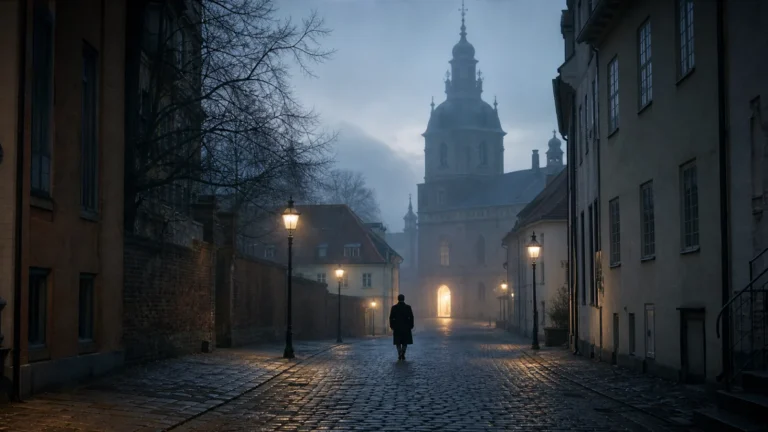
Some philosophers become historical figures. We visit them the way we visit old ruins: respectfully, at a safe distance, aware that something important happened there once.
Nietzsche is not like that.
He does not feel settled. He does not feel finished. There is still heat coming from him. Even now, more than a century after his collapse and death, his sentences can enter a room and disturb the furniture. They do not always persuade. Sometimes they offend. Sometimes they exaggerate. Sometimes they run too close to cruelty. And yet, strangely, they remain alive in a way that many safer ideas do not.
I have returned to Nietzsche at different ages, and each time I have met a different man. When I was younger, I met the dangerous stylist, the philosopher of lightning, the one who seemed to write from a height where the air was too thin for ordinary morality. Later, I met the psychologist, the suspicious reader of motives, the one who asked whether our virtues were always as clean as we liked to imagine. Later still, I began to meet the cultural physician, the thinker who saw that modern life was not merely changing its institutions but losing its spiritual center.
That is the Nietzsche who stays with me most now.
Not Nietzsche as a slogan. Not Nietzsche as a poster for rebellion. Not Nietzsche as the patron saint of arrogance, as he is sometimes foolishly made to be. But Nietzsche as a man who felt, with unusual sensitivity, that something in the modern soul had come loose.
He did not simply ask what we believe. He asked what our beliefs are doing to us.
That question has not aged. If anything, it has become more intimate.
The Philosopher at the Threshold
Nietzsche was born into a world that still carried the deep grammar of Christianity. His father was a Lutheran pastor. His childhood belonged, in part, to a European order that still knew how to speak of God, sin, duty, eternity, and salvation as if these words were not merely private preferences but pillars holding up reality.
This matters because Nietzsche did not discover the collapse of inherited meaning as an abstract topic. He did not stand outside it and write a report. He lived close to the break. He felt the old structure weakening while its moral habits continued to move through people like a memory in the body.
There is a difference between being born after a house has already fallen and being present while the beams are cracking.
Most of us were born deep inside modernity. We inherit fragmentation as normal. We grow up among career choices, personal brands, political identities, therapeutic language, private spirituality, algorithmic noise, and a strange mixture of freedom and fatigue. We do not always experience the absence of a shared sacred order as a catastrophe. It is simply the weather.
Nietzsche stood nearer the storm front. Like Kierkegaard before him and Heidegger after him, he thought from a threshold between older metaphysical certainty and the modern condition. Behind him was a world organized around Christianity. Ahead of him was a world in which human beings would increasingly have to justify their values without the shelter of God.
This is why the phrase “God is dead” is so often flattened when it is repeated. It is not a simple atheist slogan. It is not a clever way of saying religion is false. It is a diagnosis of cultural history. It means that the highest values of European civilization had lost their unquestioned foundation. It means morality remained, but its roots had been cut. It means people would continue speaking of truth, dignity, equality, justice, progress, and humanity, often with great passion, but without always knowing why these words should command obedience.
Nietzsche did not celebrate this in a shallow way. He saw the danger.
The danger was not only that people would stop believing in God. That was almost too simple. The deeper danger was that people would continue living on the emotional inheritance of beliefs they no longer truly held. They would keep the moral furniture but lose the house. They would keep the language of meaning but forget what made it meaningful.
Nihilism does not always look like despair. Sometimes it looks like a crowded life with no center.
That, perhaps, is why Nietzsche still feels near.
We are not empty people. We are full of tasks, opinions, messages, plans, anxieties, obligations, entertainments, and half-formed desires. But fullness is not the same as depth. Motion is not the same as direction. A calendar can be packed and a soul can still be starving.
Nihilism as a Cultural Mood
The word nihilism has become dramatic with use. It can sound theatrical, almost adolescent. One imagines black clothes, late-night cigarettes, and a person declaring that nothing matters with more enjoyment than he admits.
But Nietzsche’s nihilism is not a pose. It is not simply sadness. It is not even ordinary atheism. It is what happens when the values by which a culture lives no longer convince that culture, yet no stronger values have emerged to replace them.
Life continues, of course. Offices open. Children go to school. Elections happen. People marry, divorce, buy furniture, take holidays, post photographs, and answer emails. The machinery keeps moving. But beneath the movement there is a quiet loosening.
Why should I live this way?
Why should truth matter more than comfort?
Why should sacrifice be noble?
Why should one become better rather than merely more successful?
Why should anything be called higher or lower at all?
These questions rarely arrive in such clean philosophical form. More often they appear as restlessness. Cynicism. Exhaustion. A private suspicion that one’s life is being performed more than inhabited. A sense that one has many answers available, but not the one that would make the answers gather into a life.
Nietzsche matters because he refused to cover this wound too quickly. He did not rush to console. He did not paste a new slogan over the old metaphysics. He asked whether our values still had life in them, or whether they had become habits preserved by fear, politeness, resentment, or inertia.
This is not always pleasant reading. Nietzsche has a way of looking at virtue as if he suspects it of carrying contraband. He asks whether goodness is sometimes disguised weakness. Whether humility is sometimes fear. Whether pity is sometimes power. Whether moral outrage is sometimes revenge wearing ceremonial clothing.
He can go too far. He often does.
But the questions are not therefore useless. Some questions are valuable precisely because they make easy innocence impossible.
Are you sure this is virtue? Are you sure this is truth? Are you sure your certainty is not protecting you from life?
Such questions can feel rude. They are also, at times, acts of philosophical mercy. A culture can lie to itself for a long time. So can a person. Nietzsche’s severity comes from his refusal to let beautiful words remain unexamined.
The Problem with Private Salvation
In modern conversations about meaning, we often turn immediately toward the individual.
- Find your purpose.
- Become yourself.
- Heal your wounds.
- Protect your peace.
- Discover your values.
- Build your life.
There is truth here. I do not want to dismiss it. A person who has done no inner work can become dangerous without noticing. Unexamined pain leaks into love, politics, ambition, parenting, religion, and work. The unexamined self does not stay politely inside the self. It spills.
This is why philosophy has always had a therapeutic side. Socrates did not merely want better arguments. The Stoics did not merely want correct definitions. Ancient philosophy often asked a simple and difficult question: what kind of person are you becoming?
But becoming oneself is necessary, not sufficient.
There is a kind of spiritual individualism that begins as liberation and ends as isolation. At first, it frees us from inherited roles. Then, slowly, it tempts us to treat life as a private project. My healing. My meaning. My flourishing. My authenticity. My peace.
The language is gentle, but the horizon can become small.
A human being is not a sealed container of self-development. We are formed by families, languages, cities, technologies, myths, schools, economies, rituals, music, screens, and atmospheres of expectation. We belong to a culture before we learn to critique it. And culture lives inside us more deeply than we like to admit.
Nietzsche widens that question. He asks not only what habits form a person, but what values form a civilization. What does a culture reward? What does it shame? What kind of courage does it make possible? What kind of weakness does it make respectable?
Every society educates desire.
That sentence has become more important to me with time. We imagine ourselves choosing freely, and of course we do choose. But we choose inside atmospheres. We choose among options already lit up for us as admirable, shameful, realistic, childish, noble, embarrassing, successful, or strange.
A culture teaches us not only what to think. It teaches us what to admire.
And what we admire, slowly, we become.
Purity, Rigidity, and the Failure of the Noble Pose
There is an old temptation among serious people: purity.
We see confusion around us, and we become rigid. We see compromise, and we worship consistency. We see corruption, and we make an idol of our own clean hands. Something in the soul says: if the world is lost, at least I will remain untouched.
This is understandable. Sometimes it is even admirable. But it can become a subtle form of vanity.
Cato the Younger, the Roman Stoic and fierce opponent of Julius Caesar, often comes to mind here. He has been admired for centuries as an image of moral seriousness. There is much to respect in him: discipline, courage, refusal to flatter power. Yet there is also a warning. His uncompromising purity, however noble, did not save the Roman Republic. In some accounts, it made practical resistance harder. His virtue became historically ineffective, perhaps even tragically participatory in the collapse he hated.
That is painful to think about.
Virtue is not always simple. Integrity is not always the same as rigidity. A clean conscience can still have poor judgment. One can be morally impressive and still politically, relationally, or culturally unhelpful.
This is where Nietzsche becomes interesting again. He is certainly not a gentle guide to civic moderation. He is not the thinker I would hand to someone looking for calm balance. But he does help us see that the self cannot be the whole unit of philosophical concern. A person is not merely responsible for remaining personally pure. A person participates in the energies of a world.
The question is not only: am I authentic?
It is also: what does my authenticity do?
What does my seriousness produce in the people around me? Does my morality open life or close it? Does my intelligence deepen contact with reality, or does it become a beautiful method of staying untouched?
These are uncomfortable questions. But perhaps adulthood begins where the dream of moral neatness becomes impossible.
Nietzsche as a Doctor of Values
Nietzsche often imagined himself as a kind of physician. Not a physician of bodies, though the body was never far from his thinking, but a physician of culture. He diagnosed symptoms. He listened beneath official explanations. He treated moral systems not as neutral truth-machines but as living expressions of instinct, strength, weakness, resentment, fear, vitality, and exhaustion.
He does not simply ask whether a belief is true. He asks what kind of life needs that belief.
- What instinct does this morality serve?
- Does this value strengthen life or weaken it?
- Is this ideal born from abundance or resentment?
- Who benefits when certain desires are condemned?
- What kind of person is produced by this culture’s highest praise?
This is philosophy moving toward psychology. More than that, it is philosophy entering the hidden emotional life of civilization.
Science can tell us many things. It can measure, model, compare, and explain. I respect this deeply. But science, by itself, cannot decide what should be loved. It cannot prove that truth is always worth more than illusion. It cannot tell us why a noble life is preferable to a comfortable one. It cannot answer, from measurement alone, why some forms of human being should be cultivated and others resisted.
Nietzsche enters precisely there, in the dangerous space where values themselves must be questioned.
He asks why truth became sacred to us. He asks whether human beings have always needed art, myth, interpretation, and even selective blindness in order to live. He asks whether a life stripped of every comforting fiction would be more honest, or simply less livable.
These are not games. They are mature questions, even when Nietzsche asks them with adolescent thunder.
A small note: The question is not only whether our values are correct. The question is whether they are alive enough to carry us.
Nietzsche’s word for cultural sickness was often decadence. By decadence he did not merely mean luxury, softness, or moral looseness. He meant a deeper weakening of instinct, a condition in which life turns against itself, energy becomes reactive, and the capacity to affirm existence begins to decay.
A decadent culture may still be wealthy. It may still be clever. It may still have excellent devices, refined entertainments, impressive institutions, and countless opinions about justice. But beneath all this, it may no longer know how to say yes to life without resentment.
That diagnosis feels uncomfortably close.
The Inner Weather of a Civilization
There is a visible layer of culture: laws, markets, schools, technologies, architecture, media, institutions, public rituals, economic incentives. These things matter. Of course they do.
But beneath them is another layer, harder to name.
A shared mood. A structure of admiration. A collective anxiety. A spiritual climate. The quiet sense of what is allowed to be loved and what must be laughed at before it becomes dangerous.
This inner-cultural realm is difficult to study because it refuses clean handling. It appears in jokes, fashions, taboos, family patterns, political obsessions, trends in therapy, the design of apps, the stories people tell about success, and the kinds of loneliness that become normal enough not to be noticed.
Nietzsche had an instinct for this realm. Later thinkers would explore related territories in different languages. Freud would look beneath conscious intention into repression and desire. Jung would speak of archetypes and the collective unconscious. Foucault would examine power as something dispersed through knowledge, institutions, and social practices. Post-structuralist thinkers would question the stability of truth, identity, and meaning.
But Nietzsche is already there, early and wild, suspicious of surfaces.
He knows that an argument is never only an argument. A moral claim is never only a moral claim. A philosophy is not merely a collection of propositions. It is also a confession, a symptom, a mask, a strategy, sometimes even a cry from the body.
This does not mean we should dismiss ideas by psychoanalyzing whoever holds them. That would be too easy, and too often unfair. But Nietzsche reminds us that thinking is embodied. We philosophize with our wounds, our digestion, our pride, our loneliness, our fear of death, our need to be forgiven, our hunger to be seen.
No thought comes from nowhere.
Even the desire for pure objectivity has a psychology. I think this is one reason Nietzsche still belongs beside any serious reflection on thinking about thinking. He makes us ask not only whether an idea is coherent, but why it became necessary to us.
The Strange Religion of Nietzsche’s Style
There is also the matter of style.
Nietzsche does not write like a man arranging furniture in a well-lit room. He writes like weather. Aphorism, insult, prophecy, joke, psychological observation, myth, song, tenderness, cruelty, sudden laughter. His books do not always feel composed. Sometimes they feel discharged.
This is part of why he remains difficult to domesticate. You can summarize Kant and still feel that the summary belongs to Kant. You can outline Aristotle and keep much of the architecture. But Nietzsche loses something essential when he is reduced to positions. The music matters. The danger matters. The rhythm matters.
Especially in Thus Spoke Zarathustra, Nietzsche writes with an almost religious intensity. Not religious in doctrine, but religious in energy. Mountains, caves, eagles, serpents, dances, dawns, children, descents, laughter. It feels like scripture from a religion that should perhaps never become a religion.
I say that carefully.
Nietzsche can intoxicate. Anyone who reads him seriously should know this. He can make destruction feel like clarity. He can make arrogance sound like health. He can make solitude seem more noble than love. He can awaken courage, but also inflation.
Nietzsche should not be read as a master to obey. He should be read as a storm to pass through carefully.
There are passages where I feel enlarged by him, and passages where I feel I need to step away before the enlargement becomes unhealthy. That, too, is part of reading him honestly. A thinker can reveal something true and still be dangerous company. Perhaps the more alive the thinker, the more necessary our own balance becomes.
Nietzsche’s style collapses the distance between idea and force. He does not merely discuss transformation. He tries to enact it in the reader. He wants the ground under our inherited assumptions to tremble. He wants neutrality to become difficult.
That is why reading him is not like reading a manual. It is more like entering a climate. You may not leave with agreement. You may leave with better questions, sharper instincts, and a little less patience for your own beautiful evasions.
The Fertility of Disagreement
One of the strangest pleasures of Nietzsche is that one can disagree with him and still feel grateful.
With some thinkers, disagreement feels like reaching a wall. With Nietzsche, it feels like wrestling with someone who, even when wrong, makes you discover your own strength. He is rarely dull. Even his mistakes have energy. They force a response.
This matters because the point of reading philosophy is not always to find someone safe to agree with. Sometimes the point is to meet an intelligence that irritates us into clarity.
Nietzsche did this for me especially around spirituality.
There was a time when I was strongly drawn to mystical language, Eastern philosophy, enlightenment, ego dissolution, the promise of becoming transparent to something vast and luminous. I still respect much in those traditions. There are depths there that modern life badly needs. But Nietzsche made admiration harder, and that was good.
He did not oppose spirituality from the standpoint of shallow worldliness. He was not saying, “Forget transcendence, chase money and status.” That would have been easy to ignore. His challenge was more disturbing. He asked whether some forms of transcendence are secretly tired of life. Whether the desire to escape the ego can become a desire to escape the earth. Whether serenity can hide refusal. Whether the highest spiritual ideals sometimes contain a subtle revenge against the body, time, suffering, limitation, and becoming.
This did not destroy my interest in spiritual thought. It purified it, at least a little. Nietzsche made it harder for me to admire an ideal merely because it sounded elevated. He taught me to ask what an ideal does to life.
- Does it deepen presence?
- Does it make courage more possible?
- Does it strengthen love for the world as it is, not merely as we wish it were?
- Does it help a person suffer without becoming resentful?
- Or does it make a person more distant, more bloodless, more secretly contemptuous of ordinary existence?
That question applies far beyond religion. It applies to politics, productivity, wellness, moral purity, intellectual identity, and every ideology that promises innocence.
Nietzsche After Nietzsche
Nietzsche matters also because so many later roads pass through him.
Existentialism inherits his concern with freedom, becoming, responsibility, and the individual standing without metaphysical guarantees. Psychoanalysis inherits his suspicion that consciousness is not master in its own house. Postmodern and post-structuralist thought inherit his critique of truth, morality, power, and stable foundations.
He is not the source of all these traditions, and philosophy is never that simple. But he is one of the great underground rivers. Camus, Freud, Jung, Heidegger, Foucault, Deleuze, Derrida, and many others become easier to understand when Nietzsche is somewhere in the background. Not because he explains them completely, but because he opens the terrain where their questions become possible.
He stands at a crossroads:
- The ancient concern with how to live.
- The existential concern with meaning after certainty.
- The psychological concern with hidden motives.
- The cultural concern with values, power, and interpretation.
- The spiritual concern with affirmation, suffering, and transformation.
This is why Nietzsche resists classification. Is he an existentialist? A psychologist? A moral critic? A literary artist? A prophet of nihilism? A philosopher of life? A cultural physician?
Yes, and not quite.
The categories arrive too late. Nietzsche is more like a pressure point. Touch him, and several traditions begin to ache at once.
What We Must Be Careful About
Admiration should not make us careless.
Nietzsche has been misread, abused, simplified, and weaponized many times. Some of this is due to bad readers. Some of it is due to later manipulation of his work. Some of it, honestly, is because Nietzsche himself wrote in ways that invite danger.
His comments on women can be ugly and foolish. His celebration of strength can be flattened into brutality. His critique of pity can be misunderstood as permission for coldness. His contempt for herd morality can feed the ego of anyone eager to imagine himself above others.
So one must read him with openness and resistance.
A mature reader does not kneel. A mature reader listens, argues, absorbs, rejects, returns.
Callout: The point is not to become Nietzschean. The point is to become more honest in the presence of Nietzsche.
That distinction matters. Nietzsche is not a system to inhabit. He is an encounter to survive fruitfully. His value is not that he gives us conclusions we can adopt without risk. His value is that he teaches us to see the hidden life of values, the instincts beneath ideals, the wounds beneath certainty, and the exhaustion beneath certain forms of goodness.
He makes us less easily impressed by moral language. That can be dangerous if it turns into cynicism. But it can be liberating if it turns into honesty.
The Question He Leaves With Us
Nietzsche matters because the world he diagnosed has not disappeared.
We still live after the shaking of old foundations. We still inherit moral vocabularies whose roots we do not always understand. We still seek meaning in an age that often offers stimulation instead. We still confuse comfort with health, outrage with conviction, information with wisdom, and self-expression with freedom.
We still need to ask what kind of human beings our values are producing.
That question belongs not only to philosophers. It belongs to parents, teachers, artists, engineers, lovers, citizens, and anyone who senses that a life can be successful on paper and still somehow miss the point.
Nietzsche does not give us peace. Perhaps that is why I keep returning to him. He gives us a higher kind of unrest. He asks whether our beliefs help us become more alive, more courageous, more capable of love, more honest before suffering, more willing to create rather than merely inherit.
And maybe this is where his deepest challenge remains. Not in the dramatic image of the solitary genius against the crowd. Not in the thunder. Not even in the famous declarations.
But in the quieter question beneath it all:
What values would we be willing to live for, suffer for, and become worthy of?
Not the values we repeat. Not the ones that decorate our identities. The ones we embody when life becomes difficult.
And if we do not yet know what they are, perhaps that is not failure. Perhaps that is where the real philosophical life begins.