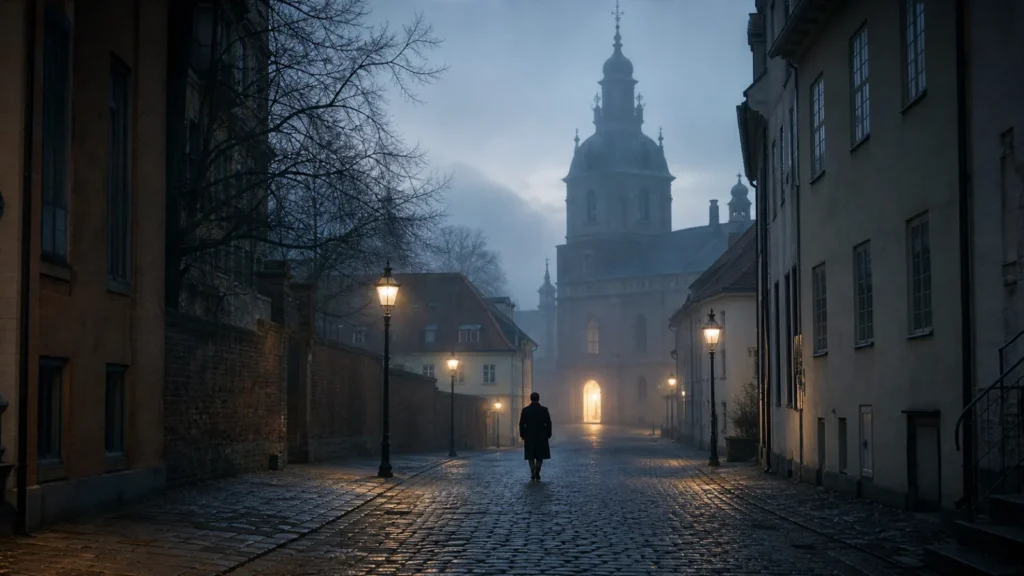
There are philosophers one studies because they are important, and there are philosophers one reads because they seem to have placed a hand directly on the nerve of existence.
Soren Kierkegaard belongs to the second kind.
He is often called the father of existentialism, which is true enough as a label and not nearly enough as an encounter. The phrase can make him sound like a historical origin point, a museum plaque placed politely before Nietzsche, Heidegger, Sartre, and Camus. But Kierkegaard is not merely the first name in a lineage. He is a disturbance. He writes as if the reader is not a spectator but a person whose life is at stake.
That is what makes him difficult. Also, that is what makes him necessary.
Unlike many later existentialists, Kierkegaard did not begin from atheism. He was a Christian, and not in the cultural, Sunday-morning, respectable sense of the word. His Christianity was inward, severe, tender, anxious, and personal. It did not allow faith to become a decoration. It did not allow the church to do one’s believing on one’s behalf. It did not allow the individual to hide behind doctrine, clergy, society, or the soothing agreement of other people.
For Kierkegaard, the central question was not simply whether God exists. It was whether a human being can stand alone before God, before freedom, before eternity, before responsibility, and become a self.
Kierkegaard does not ask us to think more cleverly about life. He asks whether we are actually living it.
This is why he still feels close. We live in a world of crowds without calling them crowds. Timelines, markets, trends, professional identities, ideological teams, lifestyle tribes, respectable opinions, curated selves. We have more ways than ever to be seen, and more ways than ever not to exist inwardly at all.
Kierkegaard saw this coming. Not the technology, of course, but the spiritual shape. The crowd would become abstract. The public would become powerful precisely because nobody in particular had to take responsibility. The individual would be flattered, entertained, informed, mocked, and absorbed, but not necessarily awakened.
Against all this, he wrote for “the single individual.”
Not the isolated ego. Not the heroic loner. The single individual: the person who cannot outsource existence.
The Wound That Became a Vocation

Kierkegaard’s philosophy cannot be separated from the atmosphere in which he became himself. His father, Michael Pedersen Kierkegaard, carried a religious melancholy so deep that it seemed to become part of the family’s climate. As a poor shepherd boy on the Jutland heath, he believed he had once cursed God. Later, after becoming wealthy in Copenhagen, that memory returned not as a detail but as a spiritual sentence.
Guilt entered the house like weather.
Soren was born into a family marked by death. Before he was fully grown, several siblings and both of his father’s wives were gone. The father believed, with terrible seriousness, that his sin would be punished through the deaths of his children. Soren inherited not only money and education, but also the feeling that existence itself was under judgment.
It is hard to imagine a childhood more suited to producing a philosopher of anxiety.
This does not mean Kierkegaard’s work can be reduced to family psychology. That would be too neat, and he would have despised the neatness. But his thought grows from a lived pressure. Death was not an abstract topic. Sin was not a church word. Eternity was not ornamental. These things had weight.
And then there was Regine Olsen.
Kierkegaard met her when she was young, became engaged to her in 1840, and broke the engagement in 1841. The exact reasons remain contested. He wrote of a secret, of inward impossibility, of a vocation that seemed to require solitude. Regine understood the break, at least partly, as religious. Others have seen in it emotional avoidance, fear, money, ambition, or a cruel sacrifice made in the name of authorship.
Perhaps all of these explanations are too simple on their own.
What matters philosophically is that Kierkegaard’s life became marked by an impossible either/or. Love and vocation. Marriage and authorship. The ethical beauty of commitment and the religious solitude of inward calling. He did not merely write about choice. He was torn open by it.
After university, the books came with almost frightening force. Between 1843 and 1846 he published an extraordinary sequence of works: Either/Or, Fear and Trembling, Repetition, Philosophical Fragments, The Concept of Anxiety, Stages on Life’s Way, and Concluding Unscientific Postscript, among others. It is one of the most intense bursts of philosophical-literary creation in modern thought.
He wrote as if time were narrow.
Maybe it was. Not biologically, as he feared, since he lived beyond the age that haunted him. But spiritually, yes. Kierkegaard did not write from leisure. He wrote from urgency. He wrote because something had to be awakened before it fell asleep forever.
Indirect Communication and the Refusal to Preach
One of the strangest things about Kierkegaard is that a man so passionately concerned with truth rarely presents truth directly.
He writes under pseudonyms. He stages voices. He creates narrators who disagree with one another. He lets one book seduce, another accuse, another tremble, another pray. He hides himself in order to make the reader visible to himself.
This method is usually called indirect communication. It can be frustrating if one wants a clean doctrine. But Kierkegaard’s point is precisely that the most important truths cannot be handed over like information. You can tell someone a fact. You cannot simply tell them how to exist.
Here his model was Socrates. Kierkegaard admired the way Socrates used irony and questioning to unsettle Athens. Socrates did not merely deliver conclusions. He forced people to discover that they did not know what they thought they knew. He made them responsible for thought.
Kierkegaard wanted something similar, but with Christian inwardness at the center. He did not want readers to repeat him. He wanted them to choose. If a reader could say, “Kierkegaard has convinced me,” too easily, then the deeper work had failed. The question was not whether Kierkegaard had an argument. The question was whether the reader had a life.
This still feels radical. We live surrounded by direct communication. Advice, instruction, opinion, diagnosis, slogan, explanation, take. Everything tells us what to think, what to buy, what to fear, what to optimize. Kierkegaard goes the other way. He creates distance so that inwardness can appear.
He refuses to do the reader’s living for him.
The truth that matters most is not the one we can repeat, but the one that changes the way we stand in our own life.
Three Ways of Existing
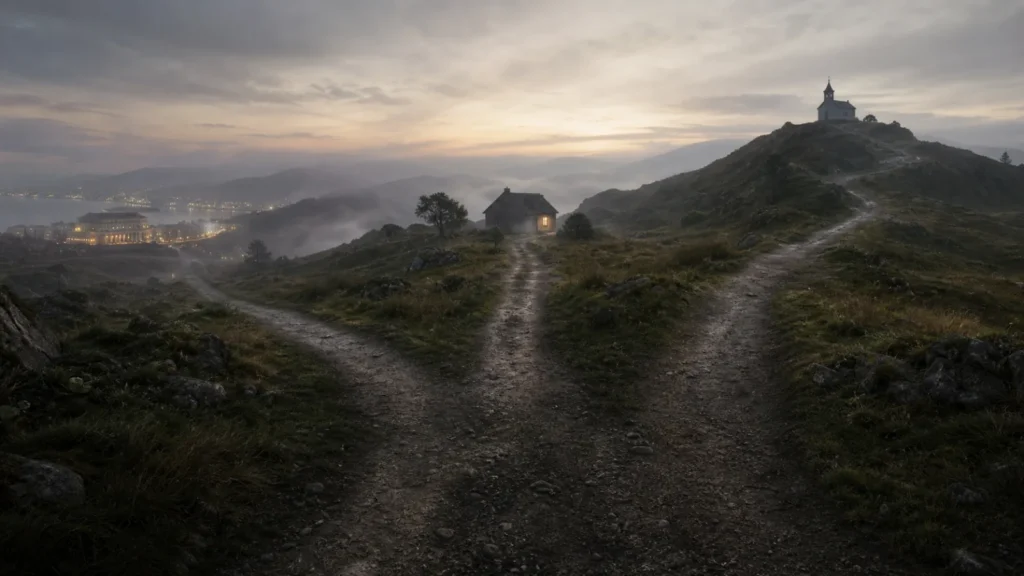
Kierkegaard’s early writings are often organized around three stages, or better, three ways of existing: the aesthetic, the ethical, and the religious. They are not rigid boxes. They are orientations of the self, ways a human being can relate to possibility, responsibility, and ultimate meaning.
What makes them powerful is that they still describe us.
The Aesthetic Life: Possibility Without Commitment
The aesthetic person lives by possibility. Pleasure, novelty, irony, interesting moods, intellectual distance, elegant avoidance. This is not only sensual indulgence, though Kierkegaard gives us Don Juan as one image of it. It can also be cultural sophistication. The person who has read everything but committed to nothing. The person who can interpret every experience while remaining untouched by any of them.
At the root of this life is boredom.
That insight feels almost painfully modern. The aesthetic life is not simply chasing pleasure; it is fleeing emptiness. Another show, another trip, another person, another opinion, another project, another identity, another little change in scenery to avoid the stillness in which the self might have to appear.
The aesthetic person wants life to remain open. Commitment feels like loss because every actual choice kills countless possibilities. So he keeps moving. He becomes clever, ironic, skeptical, charming, perhaps even brilliant. But brilliance can become a way of never arriving.
There is a sadness here. Not dramatic sadness, but a polished one. The sadness of a person who has mastered the art of escape so thoroughly that he can no longer tell what he is escaping from.
The Ethical Life: The Dignity of Commitment
The ethical stage begins when the self enters responsibility. Here one accepts duty, continuity, promise, social existence. Kierkegaard often uses marriage as an image, not because everyone must marry, but because marriage represents a decisive movement from possibility into actuality. One person, one promise, one life given shape through repetition.
The ethical life says: stop floating. Choose. Become answerable.
There is real health in this. The aesthetic self lives in a private theater. The ethical self enters the world. It recognizes that other people are not props in one’s experience. It accepts that freedom is not only the ability to keep options open, but the ability to bind oneself to something worth sustaining.
Modern self-help often lives here. Make your bed. Keep your word. Carry responsibility. Become useful. Stop drowning in abstraction. There is wisdom in that movement, especially for those who have been lost in drift. To become ethical is to discover that life can be made more real by obligation.
But for Kierkegaard, the ethical is not final.
Society can give shape, but it can also become a hiding place. Duty can mature the self, but it can also replace inwardness with respectability. A person can become admirable by every public standard and still fail to stand transparently before God.
The Religious Life: The Solitude Before God
The religious stage is where Kierkegaard becomes most difficult, most powerful, and most dangerous to domesticate. Here the individual stands not before society, but before God. Faith is not membership. It is not cultural belonging. It is not a set of inherited formulas. It is a passionate relation lived by the single individual.
This is why Kierkegaard can sound, at moments, strangely close to later existentialism and yet remain completely Christian. Like Nietzsche confronting nihilism, he distrusts the herd. Like Camus facing the absurd, he refuses cheap consolation. But Kierkegaard’s path does not end in self-created values or lucid revolt. It ends in faith.
Not faith as an explanation.
Faith as an ordeal.
Faith and the Trembling of Freedom
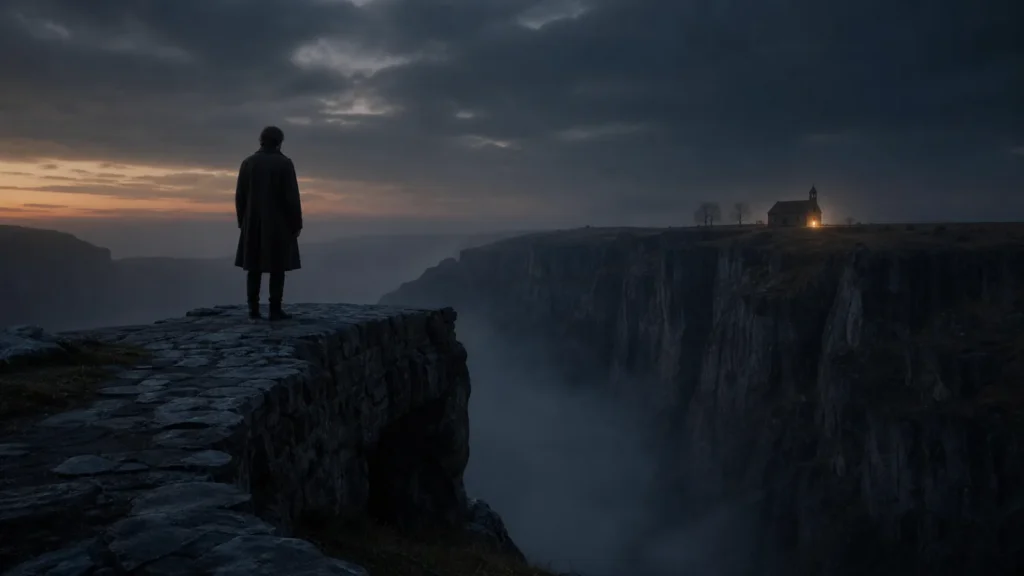
To understand Kierkegaard’s religious stage, one eventually meets Abraham.
In Fear and Trembling, Kierkegaard returns to the biblical story in which Abraham is commanded to sacrifice Isaac. It is a story many people know too well to feel. Kierkegaard makes it strange again. He refuses to let it become stained glass. He asks us to imagine the horror of it: a father, a beloved son, a command that cannot be ethically explained, and a silence in which no public language can justify what is happening.
From the ethical point of view, Abraham cannot be defended. That is the scandal. If faith could be explained comfortably by ethics, then faith would not be what Kierkegaard means by faith. Abraham stands in a relation that suspends the universal ethical order and places him absolutely before God.
This is where many readers recoil, and rightly so. How does one know the voice is God? How does one distinguish faith from delusion, obedience from madness, inwardness from danger?
Kierkegaard does not make this easy because he does not think it is easy. Faith is not a rational conclusion. It is not reached by adding premises until God appears at the end of the equation. It involves what later readers call a leap, not because thinking is worthless, but because reason cannot remove the risk from existence.
This is one of Kierkegaard’s most unsettling contributions: he sees that human life reaches moments where objectivity cannot choose for us. A person can gather information, weigh arguments, ask for advice, and still arrive at a point where the self must step forward. No crowd, system, priest, therapist, party, or theory can do the choosing.
There, anxiety appears.
For Kierkegaard, anxiety is not merely a clinical discomfort. It is the dizziness of freedom. It is what one feels when possibility opens beneath the feet. We are anxious because we can choose, and because choosing makes us responsible for becoming someone rather than someone else.
Anxiety is the soul sensing that it is free, and that freedom is not a toy.
This is why the religious life cannot be reduced to calm belief. Kierkegaard’s faith trembles. It is not the comfort of having all the answers. It is the passion of standing in the answerless place and still relating oneself to God.
I understand why some people find this intolerable. I also understand why others find it liberating. Kierkegaard strips away the false serenity that often surrounds religious language. He says, in effect: if eternity is at stake, if the self is at stake, if God is not an idea but a living relation, then why would this not shake us?
The Crowd and the Public
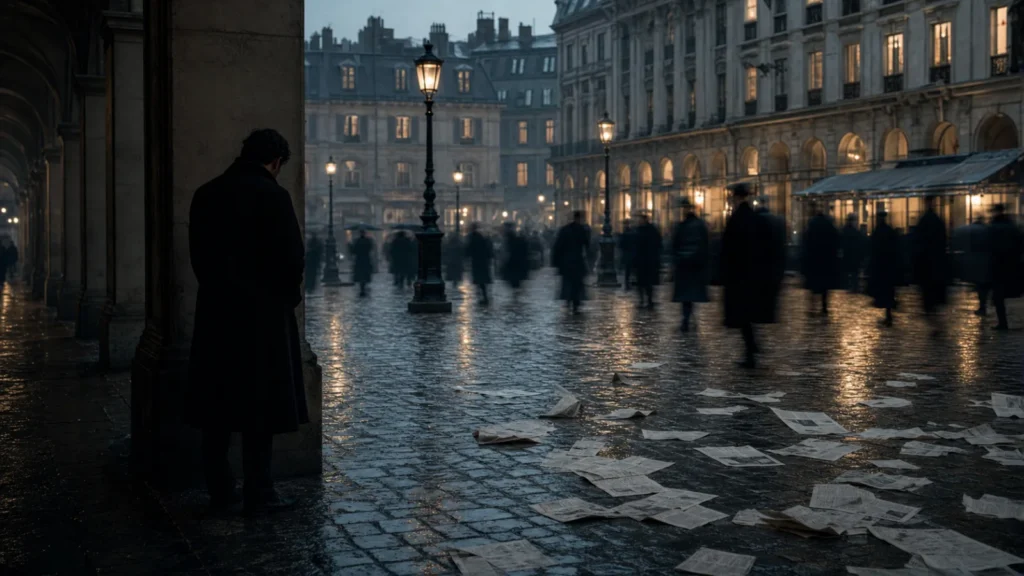
After the early works, Kierkegaard’s life took a public wound.
In 1846 he provoked The Corsair, a satirical Copenhagen newspaper. The paper responded by ridiculing him mercilessly. It mocked his appearance, his posture, his habits. The attack was not merely intellectual. It was social. Wherever he walked, people stared, laughed, and repeated the caricature.
For someone who had loved walking through Copenhagen and speaking with people from every class, this was devastating. The city became less like a home and more like a mirror held by enemies.
Out of this humiliation came a sharper analysis of the modern age. Kierkegaard began to think more deeply about the public, the press, and the crowd. He saw a new form of power emerging: abstract, anonymous, passionate about leveling, and free from personal responsibility.
The crowd does not need to be physically present. It can exist as atmosphere. It can mock without owning the mockery. It can judge without risking a self. It can flatten difference in the name of common sense. It can make inward passion look ridiculous simply by refusing to take anything inward seriously.
Here Kierkegaard becomes painfully contemporary.
We know the public he feared. We carry it in our pockets. It can elevate a person in the morning and humiliate him by evening. It can turn suffering into content, conviction into performance, and moral judgment into a form of entertainment. It is always speaking, and yet nobody in particular is speaking.
Kierkegaard’s answer is not to despise people. It is to resist the disappearance of responsibility. The crowd is untruth not because many people are always wrong, but because the crowd tempts the individual to stop being an individual. It lets us dissolve into opinion, laughter, outrage, fashion, piety, and respectable agreement.
The single individual must be recovered from this fog.
Love Beyond Preference
Kierkegaard’s later writings are not only attacks on the crowd. They are also attempts to think Christian love with frightening seriousness.
In Works of Love, he distinguishes between love as preference and love as duty. We naturally love those who attract us: friends, lovers, family, the people who fit our taste, our history, our emotional world. This love is beautiful, but it remains selective. It says: you, because you are mine, because you please me, because you complete something in me.
Christian love, for Kierkegaard, goes further. It is love of the neighbor. Not the neighbor we happen to like. Not the neighbor who confirms us. The neighbor as any person placed before us by existence and God.
This is not sentimental.
In fact, it is almost unbearably demanding. Preferential love follows inclination. Neighbor-love requires transformation. It asks us to love beyond the emotional economy of attraction and return. It asks us to see the eternal dignity of another person even when our temperament, tribe, wound, or convenience would rather not.
This is where Kierkegaard’s individualism is often misunderstood. He does not call us to become isolated private selves. The single individual stands before God so that he may become capable of loving the neighbor, not merely joining the crowd or protecting his preferences.
The self is not found by escaping others. It is found by becoming responsible enough to love them truthfully.
Despair and the Failure to Be Oneself
In The Sickness unto Death, Kierkegaard gives one of the most penetrating accounts of despair ever written.
Despair, for him, is not simply sadness. It is a spiritual misrelation in the self. A person may be cheerful, successful, admired, productive, even religiously respectable, and still be in despair. Why? Because despair is the failure to become the self one is called to become before God.
There are many forms. One person refuses to be himself. Another desperately wants to be himself on his own terms. One dissolves into the world. Another hardens into defiance. One loses himself in pleasure, another in duty, another in achievement, another in public approval.
This is where Kierkegaard becomes almost painfully diagnostic.
We can gain the world and lose the self. We can become very good at the life we are expected to live and still feel, quietly, that something essential has not appeared. We can perform competence while inwardly absent. We can be loved by an audience and unknown to ourselves.
Modern life offers countless respectable forms of despair. Career despair. Romantic despair. Identity despair. Productivity despair. The despair of endless possibility. The despair of being measured. The despair of becoming a brand. The despair of never being alone long enough to hear one’s own fear.
Kierkegaard’s cure is faith, but again, not faith as a slogan. Faith is the self resting transparently in the power that established it. That may be the most compressed way to say something enormous: the self becomes itself not by inventing itself from nothing, nor by surrendering itself to the crowd, but by relating itself honestly to God.
Even for readers who do not share Kierkegaard’s Christianity, the diagnosis remains powerful. A human being can be alienated not only from society or work, but from his own inward possibility. Despair is what happens when life continues but the self does not arrive.
The Attack on Comfortable Christianity
Near the end of his life, Kierkegaard’s tone changed. The indirect masks fell away. The playful complexity, the pseudonymous theater, the subtle seductions of the early work gave way to direct attack.
His target was Christendom.
By Christendom he meant not Christianity itself, but the social arrangement in which everyone was supposedly Christian because everyone belonged to a Christian society. Christianity had become cultural identity, public habit, state-supported respectability. It demanded little, cost little, offended little. It had become comfortable.
Kierkegaard found this unbearable.
He did not attack the church because he hated Christianity. He attacked it because he thought Christianity had been softened into its opposite. A faith founded on imitation, suffering, inward transformation, and the offense of Christ had become a polite institution managed by professionals.
He saw pastors turning the terrifying task of becoming a Christian into weekly reassurance. He saw congregations kept spiritually childish. He saw the state and church entangled in ways that made Christianity socially useful but existentially harmless.
So he became, in his own strange way, a missionary inside a Christian country.
This final phase burned hot. He published newspaper pieces and then his own pamphlet series, The Moment. The attack was relentless. Before the tenth issue could appear, he collapsed in the street. He died in 1855, in Copenhagen, at the age of forty-two.
There is something fitting and tragic in the ending. Kierkegaard spent himself against illusion. He had wanted to awaken the individual, to make Christianity difficult again, to rescue faith from the sleep of respectability. Whether he succeeded is not a simple question.
But he did make it harder to confuse belonging with belief.
Why Kierkegaard Still Matters
Kierkegaard matters because the problem he saw has not disappeared. It has become more subtle.
The aesthetic life is everywhere, but it has better design now. Endless possibility, endless content, endless self-curation, endless avoidance disguised as exploration. We call it freedom, and sometimes it is. But sometimes it is the refusal to become actual.
The ethical life is everywhere too. Responsibility, productivity, civic identity, good habits, public values, social correctness. Much of this is necessary. Without it we drift. But ethics can become another hiding place when the self confuses public goodness with inward truth.
And the religious question, even for those outside religion, remains. What is ultimate for you? Before what do you stand alone? What claim on your life cannot be delegated to society, taste, career, politics, family, or the crowd?
Kierkegaard is uncomfortable because he refuses to let us live at second hand. He does not permit us to be merely modern, merely informed, merely responsible, merely spiritual, merely Christian, merely skeptical. Always he presses inward.
Are you choosing?
Are you hiding?
Are you becoming a self, or only becoming legible to others?
These questions are not gentle. But perhaps gentleness is not always what awakens us.
The Single Individual
I keep returning to that phrase: the single individual.
It sounds simple. It is not. To become a single individual is not to become eccentric, isolated, or self-absorbed. It is to become inwardly responsible. It is to stop using the crowd as an alibi. It is to stop hiding behind cleverness, duty, taste, anxiety, or even religion. It is to stand where no one else can stand for us.
There is loneliness in that. But there is also dignity.
Kierkegaard knew that philosophy can become a way of avoiding life. One can analyze existence indefinitely and never exist. One can admire faith and never risk faith. One can praise love and never love the neighbor placed inconveniently nearby. One can talk about despair and still live inside it.
So his work remains less like a doctrine than a summons.
Not everyone will follow him into Christianity. Not everyone should pretend to. Kierkegaard himself would likely prefer an honest refusal to a borrowed piety. But even those who stand outside his faith can feel the force of his demand: do not let life happen only on the surface. Do not let the crowd think for you. Do not confuse possibility with existence. Do not confuse respectability with truth. Do not lose your soul by succeeding at everything except becoming yourself.
In the end, Kierkegaard does not leave us with a system. He leaves us with pressure. The pressure of choice. The pressure of inwardness. The pressure of a self that cannot be completed by applause, intelligence, romance, duty, or belonging.
Maybe that is why he still matters. He understood that the deepest danger is not always that we choose badly. Sometimes the deeper danger is that we never truly choose at all.
And so the question remains, quiet but severe: when the crowd grows loud, when possibility seduces, when duty comforts, when faith trembles, what would it mean for you to become a self?