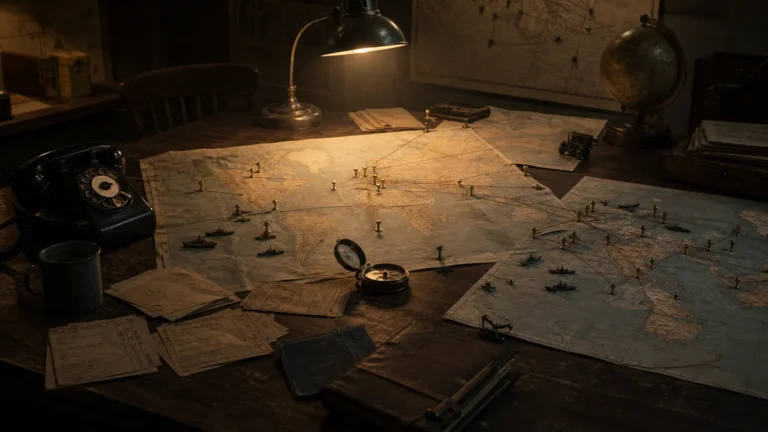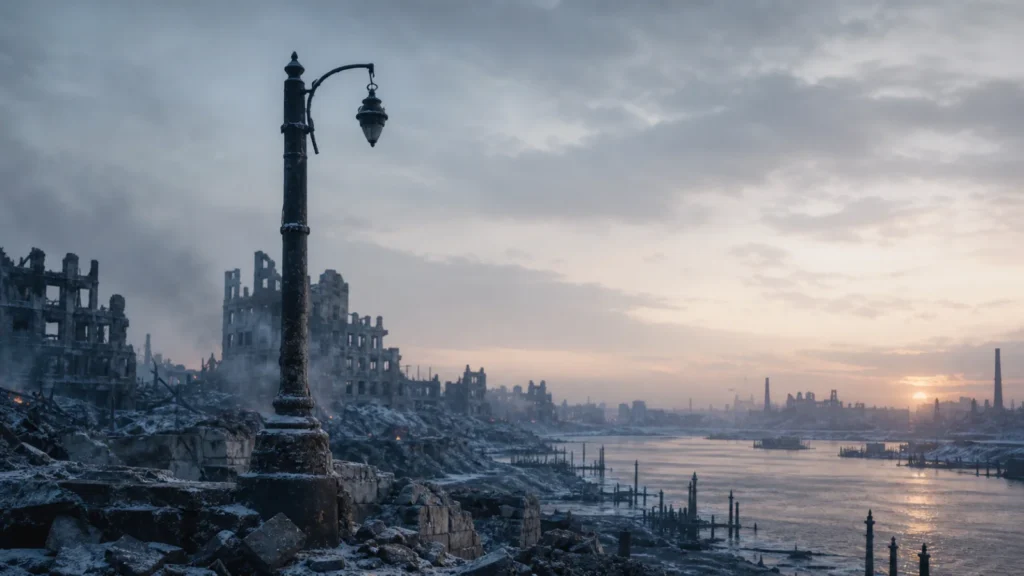
Some cities become symbols because they are beautiful. Some because they are old, or holy, or placed by history at the crossing of trade and empire. Stalingrad became a symbol because it was almost destroyed and still did not disappear.
There is something terrible in that sentence. We should be careful with heroic language around suffering, because suffering does not become noble just because later generations make statues from it. A burned apartment is not a metaphor to the person who lived there. A child carrying water through ruins is not a symbol to herself. She is cold, frightened, hungry, and trying to survive one more hour.
And yet history does this strange thing. It gathers real rooms, real bodies, real street corners, real grief, and over time it turns them into names. Stalingrad is one of those names. It no longer sounds like only a city. It sounds like an ordeal. It sounds like a warning. It sounds like the moment when the Second World War began to tilt in another direction.
But before Stalingrad was a turning point, it was home.
That is the part I find hardest to forget. Not the maps with arrows sweeping across the steppe. Not the familiar sentence that the battle changed the war, though it did. Not even the almost unbearable scale of death. What stays with me is the ordinary life that existed on the morning before catastrophe: school holidays, tram rides, hospital shifts, tea at home, the river, the factories, a mother going to work, a daughter worrying about a father at the front.
Then the sky darkened.
The battle for Stalingrad was fought by armies, but it was endured first by a city.
To understand why Stalingrad mattered, we have to hold two truths at once. It was a place trapped inside the violence of two totalitarian regimes, a city whose civilians were treated with a coldness that still shocks the conscience. It was also a place people loved, worked for, believed in, and defended not only because they were ordered to, but because it had become part of their sense of themselves.
History is rarely clean enough to satisfy our moral appetite. Stalingrad especially resists simplicity. It was propaganda and home, myth and marketplace, industrial dream and political nightmare, fortress and graveyard. Perhaps that is why it still matters. It forces us to ask what people are defending when they defend a city, and what remains of a place when almost everything visible has been taken from it.
The Day the Sky Went Dark
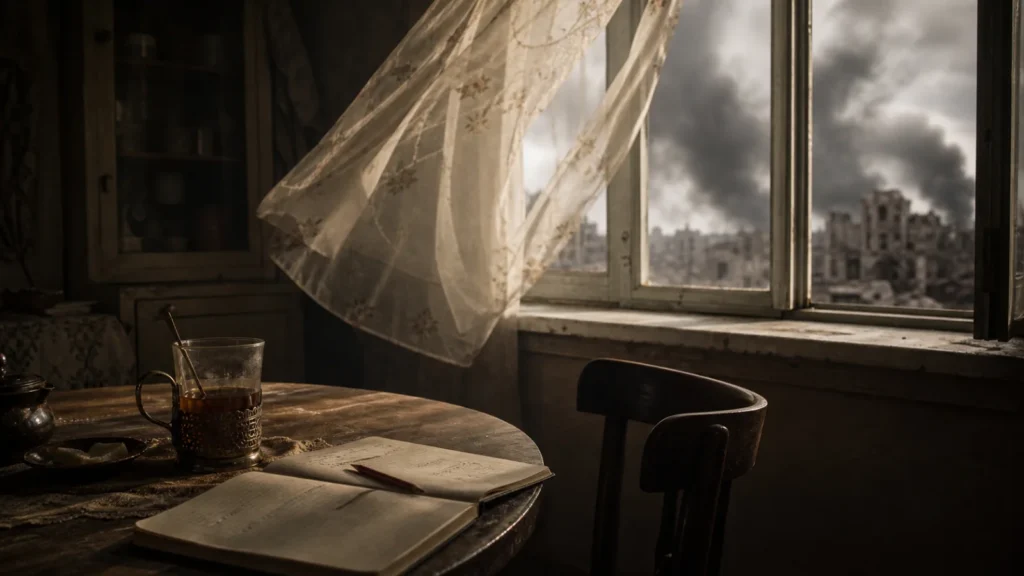
On 23 August 1942, Stalingrad was struck by one of the most devastating aerial attacks of the war. The German summer offensive had already pushed deep into the south of the Soviet Union. Hitler’s armies were driving toward the Caucasus oilfields, hoping to deprive the Soviet state of the fuel it needed to fight and to break the southern front open. Stalingrad stood on the Volga, not merely as a city with a dangerous name, but as a transport artery, an industrial center, and a hinge between geography and morale.
For civilians, strategy arrived as noise.
Maria Chuprina had just turned thirteen. She had been living in wartime, yes, but not yet in the kind of war that enters the room and changes the shape of the air. Her father was away fighting in Ukraine. Her mother worked as a nurse. School, holidays, family routines, small domestic comforts – these things continued, as they often do, right up to the edge of disaster. The morning began with tea. Then the light changed. What might have been mistaken for weather became something else entirely.
The bombing lasted for hours. German aircraft came in wave after wave. The city’s air defenses were overwhelmed and disorganized. Buildings collapsed. Fires spread. People ran toward the Volga hoping to cross, but the river itself became dangerous. Boats, ferries, and crowded crossings were attacked from above. By nightfall, tens of thousands of civilians were dead. The number often given is around 40,000 on the first day alone, a figure so large that the mind struggles to keep it human.
Numbers can become another kind of ruin. They are necessary, but they can also make suffering abstract. Forty thousand is not one grief multiplied neatly. It is forty thousand interruptions. Forty thousand unfinished meals, errands, letters, arguments, plans, and little hopes that had no time to understand what was happening.
Another young woman, Klavdiya Galkova, was twenty and working as a nurse. She remembered being on a streetcar when the aircraft came. The passengers were ordered out. People lay flat wherever they could. Some tried to press themselves into the ground, as if the earth might open and protect them. By the time she returned home after helping at the hospital, the place where home had been was rubble.
This is how a city begins to become unrecognizable: not all at once in the historian’s sentence, but street by street, house by house, through the terror of people who have to keep moving because the wounded are still arriving.
The Battle of Stalingrad is often remembered through its later images: soldiers in ruins, frost, hunger, shattered factories, snipers, cellars, the German Sixth Army encircled and starving. But the opening terror belonged especially to civilians. It belonged to people who had not chosen the timing of evacuation, who had not been given enough protection, who were left inside a city whose name had become too important to abandon and too dangerous to inhabit.
There is a moral darkness here. The Soviet leadership had seen the danger approaching. Supplies, cattle, and industrial material were moved. Civilians were not evacuated at the same speed or with the same urgency. Stalin would not easily allow the city that carried his name to be emptied in the face of the enemy. By the time full evacuation was authorized, the bombing had already begun to tear Stalingrad apart.
And still, after that first day, people stayed. Some because they had nowhere to go. Some because the work of survival trapped them. Some because their families were there. Some because the city, even burning, was theirs.
Before It Was Ruins, It Was a Promise
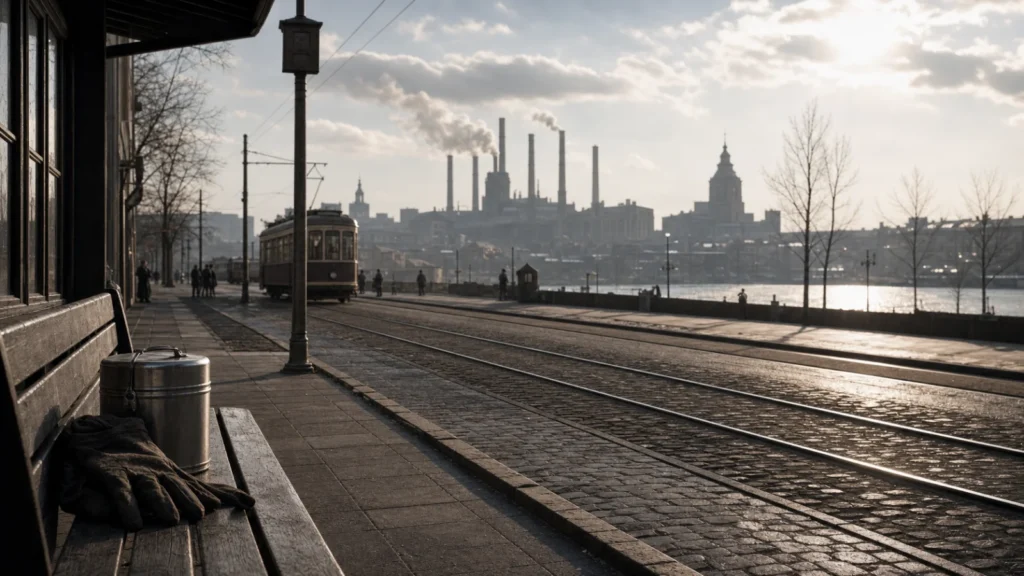
It is easy to think of Stalingrad only as rubble. History sometimes freezes a place at the moment of its greatest suffering. But Stalingrad had a life before it became an image of destruction, and that life matters because people do not defend ruins in the abstract. They defend memory, work, family, pride, and the future they had imagined there.
Before it was Stalingrad, the city was Tsaritsyn. It sat on the Volga, a river that has always been more than a river in Russian imagination. The Volga is movement, commerce, breadth, song, grain, fish, distance. A city on its banks was connected to the life of the country in practical and symbolic ways. But Tsaritsyn, before the revolution, was not yet the vast industrial city it would become. It was regional, busy, poor, limited in the opportunities it offered most of its residents.
The Soviet project transformed it. In 1925, Tsaritsyn was renamed Stalingrad, binding the city to the political mythology of Stalin’s role in the Russian Civil War. It became “Stalin’s city” in a literal sense, but also in a larger imaginative sense: a place where the Soviet state wanted to display what it claimed it could make from backwardness, poverty, and old social limits.
Industrialization arrived not as a gentle process, but as a command, a fever, a mission. The Stalingrad Tractor Factory became one of the great emblems of this transformation. Workers, engineers, young communists, and migrants came to help build the city that the new state wanted to show the world. Newspapers celebrated production. Youth organizations praised sacrifice. Socialist competition turned labor into a moral drama. To build, to produce, to exceed the quota – these were not merely economic acts. They were ways of becoming a new kind of person.
We should not romanticize this. Soviet industrialization was harsh, coercive, and often brutal. The worker’s paradise was not paradise for many workers. Dangerous labor, political fear, surveillance, shortages, exhaustion, and repression all lived inside the same streets as the cinemas, schools, libraries, trams, river promenades, and new apartments. In 1937 and 1938, the terror reached into Stalingrad as it reached across the Soviet Union. Local party members were jailed, families were frightened, accusations could destroy a life, and the presence of the secret police was not an abstraction.
Still, cities are rarely loved only because they are good. They are loved because lives become woven into them. Stalingrad by 1942 had grown astonishingly. Its population had reached hundreds of thousands. It had schools, institutes, a university, theaters, museums, libraries, trams, factories, housing blocks, river transport, markets, and the ordinary pleasures of public life. Apples, melons, cucumbers, dried fish, the smell of the river, the sound of tram wheels, workers leaving shifts, children going to school – these things existed alongside fear.
This contradiction is important. A place can be politically oppressive and still be home. A regime can lie, and yet the school it built can still teach a child to read. A factory can be part of propaganda and still become the pride of the workers who poured their youth into it. The human heart does not sort experience into clean ideological shelves.
For young Stalingraders, the city was not merely a name in a plan. It was the place where their families had risen with the century’s violence and ambition. Some had fathers or grandparents tied to the Civil War. Some had arrived through the great campaigns of construction. Some had grown up believing their city stood at the front edge of history. That belief had been taught to them, yes. But taught things can become felt things. A myth repeated often enough can become part of a person’s private courage.
So when the German army approached, Stalingrad was not just an obstacle on the way to oil. It was a storehouse of memory and identity. To surrender it would not only mean losing factories or a river crossing. It would mean watching the future they had been promised fall into enemy hands.
Why People Defended a City Already Betrayed
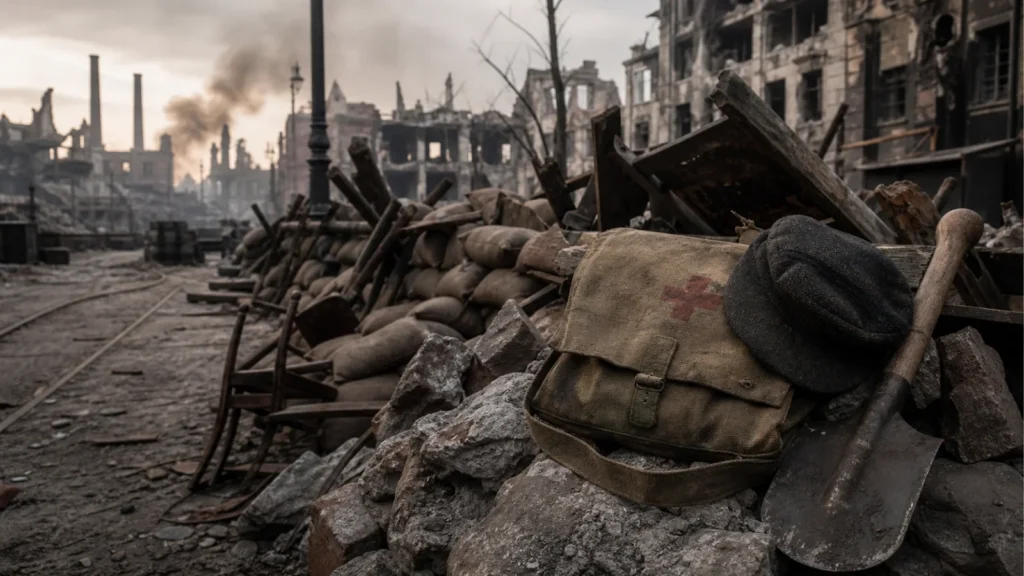
There is an easy version of Stalingrad in which Soviet citizens fought only because they were afraid of their own side. It is true that discipline in the Red Army could be severe. It is true that Order No. 227, issued in July 1942, demanded that soldiers take not one step back. It is true that fear, coercion, surveillance, and punishment formed part of the war’s reality.
But fear alone cannot explain Stalingrad.
Fear may hold a line for a moment. It does not easily explain months of endurance in basements, factories, hospital rooms, trenches, and burning streets. It does not fully explain civilians volunteering for medical work, defense brigades, communication duties, digging, carrying, repairing, warning, nursing, and all the half-visible labors by which a city tries to remain alive under assault.
Maria Chuprina, the thirteen-year-old who saw the sky darken on 23 August, went to help her mother in a makeshift hospital. She stayed through the following months, working amid the consequences of a battle no child should have been asked to witness. Klavdiya Galkova helped the wounded through the night after losing her own home. Aleksandr Eremin, a fifteen-year-old working on a steamer, carried pride in his family’s roots and in the city itself. Aleksandrova Martynova, who had once dreamed of ordinary work in a department store, trained as a radio operator and continued to pass messages from hidden command points as the battle closed around the city.
These lives remind us that history is not moved only by generals. It is also moved by nurses who keep working after the ward fills beyond reason, by teenagers who carry orders, by workers who dig trenches after long shifts, by people who do not have the luxury of waiting for a perfect moral world before deciding what must be done.
This is one of the hardest things about the Eastern Front. The Soviet state could be ruthless toward its own people, and the Nazi invasion was also a war of annihilation. For Soviet citizens, especially in places under direct threat, the question was not whether their government deserved uncritical love. The question was whether the invader could be allowed to take everything. In Stalingrad, the answer was no.
There is a kind of moral clarity that arrives not because the world becomes pure, but because one threat becomes unmistakable. The Wehrmacht was not simply an army passing through. It carried with it the violence of Nazi ideology, occupation, starvation, racial hierarchy, and destruction. For those in its path, defending the city could mean defending life itself, even when the state commanding that defense had already failed them in terrible ways.
In the factories and streets, civilian defense brigades formed around workplaces. Workers, teachers, homemakers, young communists, and others not suited for regular frontline service learned to dig, build, watch, carry, and prepare. Some of this earlier work may have seemed almost theatrical when the front was distant: searching for spies, worrying about parachutists, rehearsing dangers that had not yet arrived. Then danger arrived for real, and rehearsal became fate.
In August, trenches were dug and barricades built. Tram rails, bricks, furniture, sandbags, factory materials – the city began to use its own body to defend itself. Hospitals moved into makeshift spaces. Command posts hid in basements and caves. The line between military and civilian life blurred until it became almost meaningless. The city became an organism under attack.
That phrase can sound too poetic, so let me make it plainer: people did whatever there was to do.
There is something deeply human there. When a catastrophe becomes large enough, the question “What is the meaning of this?” often gives way to “Where am I needed?” I have written elsewhere about Camus and the courage of the absurd, and Stalingrad brings that question into history with a frightening concreteness. The work itself becomes a form of refusal. Carry the bandage. Send the message. Hold the crossing. Dig the trench. Keep the wounded alive. Return to the post.
Sometimes courage is not a feeling. It is the repetition of duty after fear has already made its argument.
The Volga and the Edge of Survival
The Volga runs through the story of Stalingrad like more than geography. It was a route, a barrier, a source of water, a line of supply, a possible escape, and at times a place of death. Rivers often carry a double meaning in war. They promise movement, but they also expose the person trying to cross. They connect a city to the world, and then, under fire, they become the narrow edge on which that connection almost breaks.
For the Soviet defenders, the western bank of the Volga became a last margin. Behind them was water. In front of them was the German assault. The phrase “back to the river” sounds almost literary, but in Stalingrad it was physical. There was not much room left for retreat, and in that lack of room the battle took on its desperate shape.
Supplies crossed the river. Reinforcements crossed. The wounded crossed back when they could. Civilians tried to cross too, not as strategic actors but as people seeking the simplest possible miracle: to be on the other side of danger. Yet the river was watched by aircraft and artillery. A crossing could save a life or end it. To move toward the Volga was to move toward hope and exposure at the same time.
This is one reason Stalingrad feels so compressed in memory. The battle was enormous, spread across armies and steppe, but inside the city everything narrowed. Streets narrowed. Rooms narrowed. Choices narrowed. The human world became a strip of land, a basement, a factory hall, a boat in the dark, a staircase held through another attack.
I think we sometimes misunderstand endurance because we imagine it as something broad and noble, like a banner lifted into the wind. More often it is narrow. It is one more trip for water. One more message sent. One more night in a cellar. One more crossing attempted while the sky watches. Endurance does not always expand the soul. Sometimes it reduces life to essentials so severe that only afterward can anyone call them heroic.
The Volga also mattered because it refused to let Stalingrad become only a closed grave. However battered the city became, the river still suggested a world beyond the ruins. It carried the idea that the Soviet heartland remained connected to this wounded place, that the battle was not happening in complete isolation. A city cut off in every other way could still face the water and know that something larger remained.
That may sound sentimental, but geography shapes courage more than we admit. A mountain, a bridge, a road, a river – these are not passive backgrounds. They enter the psychology of a battle. At Stalingrad, the Volga was the city’s last open sentence.
The City as Myth, Home, and Battlefield
Stalingrad’s symbolic value was impossible to separate from its military value. The name mattered because Stalin’s name was inside it. Hitler understood that. Stalin understood it too. A battle for a river city became a battle for prestige, ideology, and historical narrative long before the fighting ended.
But to reduce Stalingrad to the egos of dictators would be another simplification. Cities are not chess pieces even when dictators treat them that way. A city is a million small attachments gathered into streets. It is where people know which tram to take, which kiosk sells what, which bench catches the river wind, which doorway smells of soup, which factory whistle marks the hour. The symbolic city and the lived city overlap, but they are not the same.
In Stalingrad, those two cities were forced together. The mythic city demanded defense. The lived city made defense intimate. People were asked to protect a political symbol, but they also protected workplaces, hospitals, schools, neighborhoods, and the graves and memories of their families.
This is why I distrust the idea that propaganda is simply a mask placed over reality. Often propaganda works by taking some real feeling and bending it toward the state. Pride in a factory can be real. Love of a city can be real. Gratitude for education, housing, or work can be real. So can fear of the secret police. So can resentment. So can grief. The state does not need to invent every emotion. It can organize them, discipline them, amplify them, and then claim ownership over them.
The people of Stalingrad were not blank pages written upon by ideology. They were also not free individuals floating outside history. They lived inside a world of slogans, institutions, memories, punishments, ambitions, songs, schools, queues, factories, and families. Their motives were mixed because human motives usually are.
Perhaps that is what makes their endurance more moving, not less. Pure heroes are easy to admire from a distance and impossible to recognize up close. Real people are more difficult. They are afraid and proud, obedient and stubborn, shaped by propaganda and still capable of genuine devotion, abandoned by power and still willing to defend one another.
The Price of Holding On
After the bombing, the battle narrowed into an almost unimaginable form of urban war. German forces pushed into the city. Soviet defenders clung to strips of land near the Volga. Factories became fortresses. Apartment blocks became positions. Staircases, cellars, workshops, and courtyards became military geography. The distance between life and death could be a wall, a doorway, a floor.
The fighting through September and October was ferocious. Stalingrad seemed close to falling more than once. The German advance reached deep into the city, yet the Soviet defenders held enough ground to keep the battle alive. Reinforcements crossed the Volga under fire. The river was both lifeline and danger. On one bank, men and supplies moved toward the ruins. On the other, wounded and civilians tried to move away from them.
What makes Stalingrad so horrifying is not only the scale of death, but the closeness of it. Modern war is often imagined as distant machinery: artillery, aircraft, tanks, vast operations. Stalingrad had all of that, but it also had hand-to-hand terror inside broken rooms. It was mechanized war forced into intimate spaces.
The city’s own industrial achievements became part of its suffering. Factories that had represented Soviet modernization became battlefields. Machinery, walls, cranes, rails, workshops, and housing blocks were folded into the logic of survival and destruction. Even scorched-earth preparations showed how absolute the struggle had become. If the Soviet defenders could not hold certain industrial assets, they were prepared to destroy them rather than let them serve the invader.
Here, the city defended itself by being willing to lose itself. That is a strange and tragic kind of loyalty.
For civilians still trapped inside, life shrank downward. People hid in cellars, caves, dugouts, sewers, and basements. Food became scarce. Water was dangerous to fetch. Fire, cold, dust, disease, and fear became the elements of daily existence. The visible city was being pulverized above them, but underground some form of human continuity persisted. Someone still searched for bread. Someone still tended a child. Someone still listened for footsteps and aircraft. Someone still remembered what the street had looked like before.
On 19 November 1942, the Soviet counteroffensive began. Operation Uranus struck the Axis forces on the flanks, where Romanian and other allied troops were less able to withstand the assault. Within days, the German Sixth Army and other Axis forces in and around Stalingrad were encircled. The hunters became trapped in the ruin they had helped create.
Encirclement did not end the suffering. It changed its direction. Winter came. Hunger, frostbite, disease, exhaustion, and hopelessness spread among the trapped Axis soldiers. Hitler refused timely withdrawal. Soviet forces tightened the ring. The city remained a furnace, then a frozen trap. The remnants of the German Sixth Army surrendered at the end of January and beginning of February 1943. By 2 February, the battle was over.
By then, close to a million people were dead in the city and the surrounding steppe, depending on how one counts the military and civilian losses across the full battle. The number is so immense that it almost becomes mute.
Victory had arrived, but it did not look like victory if you stood inside the city.
Victory, Reconstruction, and the Burden of Memory
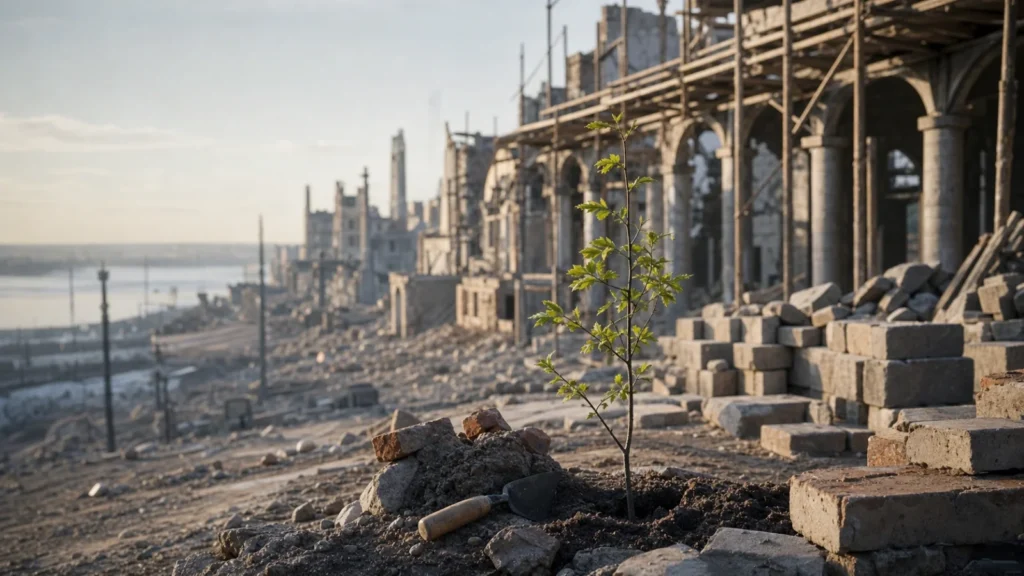
When the battle ended, Stalingrad was barely habitable. The city’s housing was shattered. Its amenities were gone or ruined. Survivors lived among corpses, disease, hunger, rubble, cold, and the terrible practical work that follows military glory. We speak of liberation and victory because those words are historically true. But for the people in the ruins, victory still required finding shelter.
Only a small fraction of the prewar civilian population remained in the city by the end. Many had died. Many had fled. Many had been evacuated too late or not at all. Those who survived did so in conditions that must have made ordinary language feel indecent. What do you call a home when the ceiling is gone? What do you call a street when the buildings have no faces? What do you call a city when the dead are still close to the surface?
And yet almost immediately, Stalingrad was asked to become a symbol again. The Soviet state launched a vast campaign to rebuild the Hero-City. This was practical, political, and spiritual all at once. The city that had stopped the invader would not be left as a grave. It would be raised again, larger in meaning than before. Plans imagined new public buildings, restored streets, renewed housing, factories, cultural institutions, and transformed landscapes. The Volga-Don canal, hydroelectric projects, and greening campaigns all belonged to this larger vision of reconstruction and mastery.
There is something moving in reconstruction. To lay bricks after annihilation is an act of faith, even when the state organizes that faith for its own purposes. A wall rises where there had been smoke. A tram line returns. Children enter schools. People plant trees. Markets reopen. Someone hangs curtains. Someone cooks in a room that did not exist last year. Life, stubbornly, resumes its small claims.
But reconstruction can also become a second kind of forgetting if it is too eager. New stone can cover old grief. Ceremonies can simplify the dead. The heroic story can make less room for hunger, abandonment, terror, and the slow humiliations of survival. A rebuilt city can be asked to shine before it has been allowed to mourn.
Viktor Nekrasov, who had served as a young sapper during the battle, later returned and found traces of the dead still present beneath shallow soil. That image stays with me because it says something about memory itself. History is never as buried as we think. The earth remembers differently from monuments.
In 1961, Stalingrad was renamed Volgograd as part of the Soviet move away from Stalin’s cult of personality. The name changed, but the memory did not vanish. Each name carries a different weight. Tsaritsyn belongs to the older city. Stalingrad belongs to industrial myth and wartime ordeal. Volgograd belongs to the river and to the city that continued living after both empire and Stalinism had shifted around it.
On 23 August, the city still remembers the day of bombing. A minute of silence is observed in memory of the first strike and the civilians killed. There is a particular dignity in silence when words have become too familiar. Silence does not explain. It allows presence.
What Stalingrad Asks of Us
It is tempting to end with the familiar lesson: Stalingrad turned the war. This is true. After Stalingrad, the German advance in the East never fully recovered its old momentum. The Soviet Union moved from survival toward strategic initiative. The road from Stalingrad would eventually lead through Eastern Europe and to Berlin.
But there is another lesson, quieter and less useful for speeches.
Stalingrad shows how much of history is carried by ordinary people before it becomes history. The civilian who carries water does not know she is inside a turning point. The nurse does not think in terms of geopolitics while the wounded are brought in. The teenager sending messages from a basement does not experience herself as a line in a future book. They are doing what the hour demands. Only later does the world arrive with names.
Maybe this is why the story continues to disturb me. It refuses to let courage remain clean. Courage at Stalingrad existed beside coercion, propaganda, fear, abandonment, and unspeakable loss. It was not the courage of a pure world. It was the courage available inside a broken one.
That may be the only kind of courage history usually offers.
We should honor the defenders without becoming intoxicated by war. We should remember the victory without forgetting the civilians who paid for it. We should understand the symbolic power of Stalingrad without allowing symbolism to swallow the child drinking tea before the bombs, the nurse returning to rubble, the worker digging a trench, the survivor planting a tree among bricks.
A city is never only its buildings. It is also the commitments that survive when the buildings fall. Stalingrad’s tragedy is that so much had to be destroyed before the world understood that. Its dignity is that even in destruction, people continued to act as if something still deserved to be saved.
When I think of Stalingrad, I do not first imagine victory parades. I imagine a lamp standing in a ruined street, a river moving past ash, a notebook left open on a table, a shovel beside a barricade, a sapling planted in broken ground.
Perhaps that is all memory can do at its best. Not rescue the dead from death, not purify the past, not make suffering meaningful by force, but keep asking the living to look carefully.
And if a city can be almost erased and still leave this question behind, maybe we should sit with it longer: what, in our own lives, would we defend even after every easy reason for hope had burned away?