We usually meet the Greek gods in a list.
Zeus has the thunderbolt. Poseidon has the trident. Athena is wise, Ares is violent, Aphrodite is beautiful, and Hermes is in a hurry. The arrangement is tidy enough to memorize before an exam, and almost useless for understanding why these beings mattered.
Ancient worshippers did not encounter their gods as a cast of fictional characters waiting inside a book. The gods were present in the calendar of the city, in the risk of childbirth, in the oath made before a court, in the first wine poured at a meal, in the terror of a storm at sea. Athena was not simply a personality. She was woven into the identity of Athens. Demeter was not merely a grieving mother in a compelling story. She belonged to grain, loss, return, and a mystery through which initiates hoped to stand differently before death.
This world can feel familiar because its stories have never quite left us. It is also stranger than we often allow. Greek religion had no single scripture, no universal creed, and no church governing belief across the Greek-speaking world. What joined communities was not perfect agreement about theology. It was inherited practice: sacrifice, procession, festival, prayer, libation, dedication, and the careful maintenance of a relationship between mortals and powers greater than themselves.
The Greek gods were not explanations placed above life. They were ways of meeting the forces already moving through it.
And so the more interesting question is not simply, Who were the Greek gods? It is this: what kind of world becomes visible when the sea has a temper, wisdom has a face, the household flame is holy, and even civilization knows it may need a god of ecstasy?
A World Crowded With Divine Presence
The old Greek landscape was not empty matter. Mountains, springs, caves, groves, rivers, cultivated fields, and the sea could all carry divine significance. A sanctuary might dominate a city from a rocky height, as Athena’s did on the Athenian Acropolis. Another might stand where geography itself seemed to announce a god, as Poseidon’s temple did above the water at Sounion. Nymphs belonged to springs and wooded places. River gods could receive offerings. Heroes, dead but still locally powerful, had shrines of their own.
The familiar Olympians lived inside this crowded sacred ecology. They were immensely important, but they did not exhaust it. The phrase Greek religion can mislead us into imagining one standardized system. In reality, practices varied by city, region, family, period, and occasion. The Athena honored in Athens was not irrelevant elsewhere, but in Athens she was inseparable from local memory and citizenship. Artemis could be approached as a huntress in one setting and as a protector of girls approaching marriage in another. Zeus himself gathered so many epithets that his worshippers could address distinct aspects of his power: guardian of oaths, protector of strangers, bringer of rain, defender of the household enclosure.
An epithet was more than ornamental language. It told a worshipper which god, in which capacity, was being approached. The divine name was broad; the cult title brought it near.
This is one reason the gods resist modern personality profiles. Their myths give them recognizable character, but cult gives them location and purpose. A story may show Hera raging at Zeus’s infidelity. A community at Argos could encounter her as the majestic center of a major sanctuary. Poseidon may appear in poetry as irritable and vengeful, yet to sailors and coastal cities his favor concerned the most practical question imaginable: whether they would reach shore.
Historical note: Greek myth and Greek worship overlap, but they are not the same evidence. A poem tells us what could be imagined about a god. An altar, inscription, votive object, or festival calendar tells us how people approached that god in a particular place.
Myth Gave the Divine Family a History
Every family tells stories about how it came to be. The Olympian family told a story about the coming of order through violence.
In Hesiod’s Theogony, composed around the late eighth or early seventh century BCE, the beginning is not a neat creation from nothing. First comes Chaos, a gap or yawning openness. Gaia, Earth, follows; then Tartarus, Eros, and other primordial powers. Gaia produces Ouranos, Sky, and together they become ancestors of the Titans. Divine generations emerge, struggle, overthrow one another, and divide authority.
Cronus, the youngest Titan in Hesiod’s genealogy, topples Ouranos and then fears the same fate from his own children. He swallows them as they are born. Rhea saves the youngest, Zeus, by substituting a wrapped stone. Zeus grows, forces the release of his siblings, defeats the Titans with allies whom Cronus had suppressed, and establishes the rule associated with Olympus.
One small correction matters here. Cronus, father of Zeus, is not simply the same figure as Chronos, the personification of time. Ancient and later traditions sometimes drew them together, helped by the similarity of their names, but treating them as automatically identical flattens a complicated history.
The succession myth does something more interesting than provide a divine family tree. It turns political order into a cosmic achievement. Zeus does not inherit a peaceful universe. His authority comes after conflict, alliance, liberation, and the distribution of honors among the gods. Even stable order remembers the violence beneath it.
There is no need to pretend that every Greek understood these poems in exactly the same way. Hesiod was influential, not a legislator of belief. Homeric epic, local stories, hymns, drama, and cult traditions could preserve different genealogies or emphasize different relationships. Myth was an active language, not a frozen catechism.
Why the Twelve Were Never Quite Twelve
The expression “Twelve Olympians” suggests a settled committee. Ancient evidence is less cooperative.
A group of twelve gods was certainly meaningful. An altar of the Twelve Gods stood in the Athenian Agora by the late sixth century BCE, and literary evidence also preserves sacrifices divided into twelve portions. Yet surviving lists are not perfectly identical. Zeus, Hera, Poseidon, Athena, Apollo, Artemis, Aphrodite, Ares, Hephaistos, and Hermes form a fairly stable center. Hestia and Dionysos can shift according to the list. Demeter is commonly included. Hades, although a brother of Zeus and one of the greatest gods, usually resides outside the Olympian twelve because his kingdom is below, not on Olympus.
Helios offers another useful complication. He is a divine sun god with an ancient lineage and a vivid presence in myth, especially in the eastward island world and at Rhodes. But he is not normally counted among the canonical Olympians. Later Greek and Roman thought increasingly connected Apollo with the sun, yet Apollo and Helios should not be collapsed into one another across every period.
The same caution applies to Artemis and the moon. Later traditions associate her strongly with lunar divinity, particularly through identification with Selene and other goddesses. In earlier Greek religion, Artemis is more securely the mistress of wild animals, hunting, transitions, and the dangerous edges around maturation and childbirth.
Our hunger for the definitive list says something about us. We like clean systems. Ancient religion was often comfortable with overlap. A god could change emphasis from place to place without ceasing to be recognizably the same god. Boundaries existed, but they breathed.
The Great Powers of Olympus and Below
Zeus, Hera, Poseidon, and Hades
Zeus stands at the center of Olympian order. The thunderbolt is his most recognizable weapon, but weather is only the beginning. He protects oaths, strangers, suppliants, political order, and the rules that make human trust possible. Myth rarely makes him morally tidy. He can be majestic and calculating, guardian of justice and serial violator of his own marriage. Greek divinity was not an instruction that power must look innocent.
Hera, both sister and wife of Zeus, governs marriage and queenship. Modern retellings often reduce her to jealousy because so many myths place her anger around Zeus’s affairs. But jealousy is not a divine portfolio. Hera’s cultic weight, especially at Argos and Samos, reveals a goddess far larger than the role of wronged spouse. She presides over the legitimate shape of marriage even while her own marriage exposes its humiliations.
Poseidon receives the sea when the brothers divide the cosmos. His trident, horses, earthquakes, and sudden anger all belong to a world in which the ground and water could turn deadly without warning. For a maritime culture, this was not colorful mythology. It was a recognition that prosperity and catastrophe could arrive on the same tide.
Hades receives the underworld. His name can also designate the realm itself, which perhaps explains how easily he becomes confused with death as such. Yet the Greeks also personified death as Thanatos. Hades is better understood as ruler and keeper of the dead. He is feared, wealthy in the sense that everything buried belongs below, and comparatively remote from the vivid social quarrels of Olympus.
Athena, Apollo, and Artemis
Athena is born, in one famous tradition, from the head of Zeus: armed intelligence entering the world without infancy. She joins strategy to craft, war to disciplined thought, civic protection to weaving. This is a combination worth lingering over. The same intelligence that arranges troops can arrange threads. Skill is not divided neatly into mental and manual forms.
Apollo governs music, prophecy, archery, healing, and plague. At Delphi, petitioners asked his oracle questions whose answers could shape private decisions and public policy. His beauty is not softness. Apollo’s clarity can wound; his arrows bring sudden death as well as protection. He embodies order, measure, and distance, but also the frightening fact that knowledge arrives on terms not chosen by the questioner.
Artemis, Apollo’s twin, belongs to the wild places beyond cultivated order. She is a huntress and protector of young life, yet her myths can be severe. Girls and women met her especially around vulnerable transitions. At Brauron in Attica, ritual service connected young girls with Artemis before marriage. Once again, the category “goddess of the hunt” is accurate and too small.
Aphrodite, Ares, Hephaistos, and Hermes
Aphrodite gives divine form to attraction, erotic desire, beauty, and the destabilizing force by which one being reaches toward another. Hesiod’s poem brings her from sea foam after the mutilation of Ouranos; another tradition makes her the daughter of Zeus and Dione. Contradiction did not make the goddess disappear. Desire itself rarely arrives with a consistent genealogy.
Ares is the shock and blood of battle. Where Athena can represent disciplined strategy, Ares carries war’s fury, panic, and appetite. Greek poetry is often wary of him. Still, a culture familiar with war could hardly deny that this force belonged among the gods. Not everything sacred was admirable. Some powers were honored because they were dangerous.
Hephaistos is the divine smith, master of fire and metalwork. He is also marked by bodily difference: in poetry he is lame, mocked, cast down, and yet indispensable. The gods depend on objects made by the one they ridicule. His presence complicates any easy Greek cult of bodily perfection. Skill creates its own authority.
Hermes moves. He crosses boundaries between divine and human, living and dead, lawful exchange and clever theft. He protects travelers, heralds, merchants, shepherds, and roads. As a guide of souls he can descend where most Olympians do not. He is less a god of one territory than of passage itself.
Demeter, Dionysos, Hestia, and Helios
Demeter belongs to grain, cultivation, and the continuity on which settled life depends. Her grief for Persephone brings agriculture into contact with bereavement. The field looks dead, returns, and dies again; human beings cannot help seeing themselves in that rhythm.
Dionysos is wine, theater, altered identity, procession, and the loosening of ordinary boundaries. He can arrive as joy or danger, community or dismemberment. A society that prized measure still made room for sacred loss of measure. Perhaps it understood that order becomes brittle when it has nowhere to release what it excludes.
Hestia is quieter. She is the hearth, the stable center of household and civic fire. Her relative scarcity in narrative should not be mistaken for insignificance. Fire received the first and last portions of offerings in some traditions. The least dramatic goddess may have been among the most continuously present.
Helios drives the sun’s course and sees what happens beneath him. His all-seeing quality makes him a witness in myth, while his cattle become central to a disastrous episode in the Odyssey. He reminds us that the Olympian scheme was never the whole sky.
The Gods of the City
Religion in a Greek polis was not sealed inside private conviction. It was public time.
Festivals interrupted ordinary labor, organized processions, displayed social groups, offered sacrifice, hosted contests, and renewed the story a community told about itself. At Athens, the Panathenaia honored Athena Polias, Athena of the city. The greater festival, held every four years, included musical and athletic contests, a grand procession, sacrifices, and the presentation of a woven peplos to the goddess.
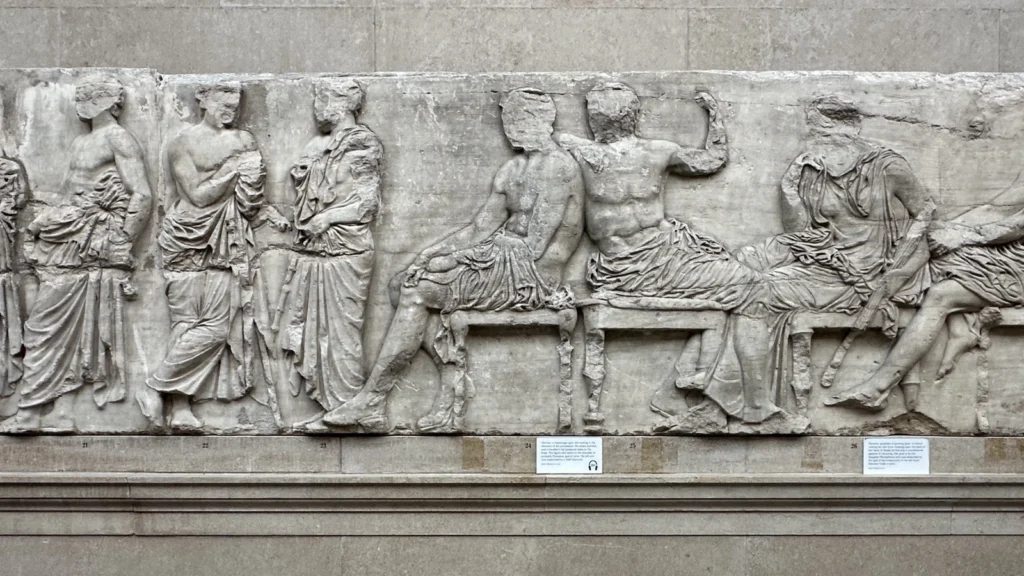
The surviving Parthenon frieze is usually interpreted in relation to this civic procession, though details remain debated. Its most remarkable effect is not simply that gods appear. It is that gods and citizens inhabit the same carved event. The deities sit at a scale larger than mortals, yet the city approaches them in ordered movement. Religion here is architecture, cloth, animals, bodies, music, rank, labor, and memory brought into one public form.
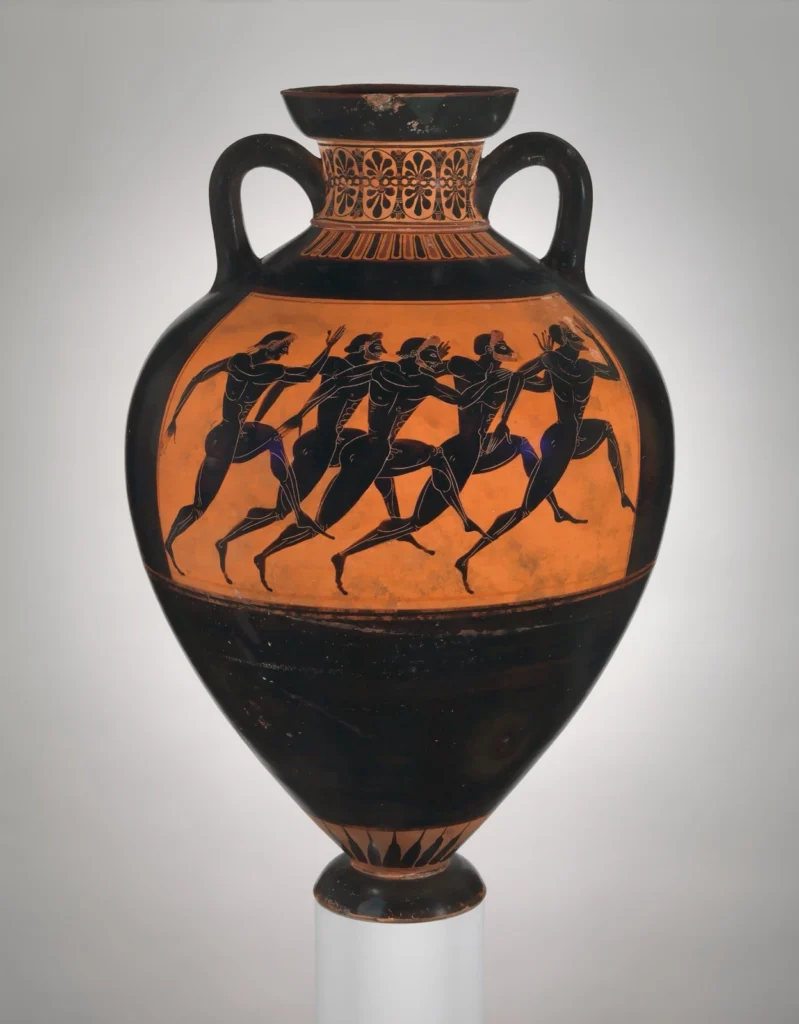
The Panathenaic prize amphora makes the relationship wonderfully concrete. On one side stands armed Athena; on the other, athletes compete. The vessel itself carried olive oil from sacred trees and became a prize worth taking home. Divine patronage, civic identity, agricultural wealth, craftsmanship, and bodily excellence all met in one object.
Other sanctuaries drew worshippers beyond a single city. Olympia honored Zeus through games. Delphi gathered the Greek-speaking world around Apollo’s sanctuary and oracle. The festivals at Nemea and the Isthmus similarly joined religious observance to competition and prestige. “Greekness” was politically fractured, sometimes violently so, but sacred places offered occasions on which a wider cultural world could recognize itself.
Worship Was a Relationship of Exchange
Modern discussions of religion often begin with belief: what propositions did a person accept? Greek practice asks us to begin elsewhere. What did people do?
They prayed, poured libations, burned incense, dedicated objects, processed to sanctuaries, kept festivals, consulted oracles, and sacrificed animals. A sanctuary was typically a marked sacred precinct, a temenos, containing an altar and often a temple with a cult image. The temple housed the god’s presence and possessions; the altar outside was frequently the center of public ritual.
Animal sacrifice joined reverence, hierarchy, and communal eating. The gods received portions through burning and smoke; human participants shared meat under rules that could express status and belonging. The act was not reducible to slaughter, feast, or symbol. It was a negotiated meeting between mortal community and divine recipient.
- Prayer named the god and the relevant power or epithet.
- Libation offered liquid, often wine, in formal gestures of honor.
- Votive dedication left an object in gratitude, petition, or remembrance.
- Sacrifice created a shared ritual event between deity and community.
- Festival placed worship inside the public calendar and civic body.
- Divination sought signs or answers where mortal knowledge reached its limit.
This has sometimes been summarized by the Latin phrase do ut des, “I give so that you may give.” The phrase captures reciprocity but can sound too commercial. Ancient worshippers were not putting coins into a cosmic vending machine. They were sustaining a relationship in which gratitude, obligation, prestige, fear, hope, and memory all had a place.
Nor was Greek priesthood identical to a modern clergy. Priestly offices were often tied to particular cults and could be civic, hereditary, temporary, purchased, or selected under local rules. There was no single institution defining orthodoxy everywhere. What mattered greatly was performing the inherited rite correctly and respecting the boundaries of the sacred.
The Divine at the Hearth, Gate, Road, and Sea
Grand temples dominate our imagination because stone survives. Daily religion often happened in materials and gestures that did not.
Hestia’s hearth fire gave the household a sacred center. Zeus could be honored in domestic aspects as protector of property, enclosure, ancestry, or stores. Offerings accompanied meals and life transitions. Graves, family memory, local heroes, and the dead formed another field of obligation. We should be suspicious of any picture in which ordinary Greeks only became religious when they climbed temple steps.
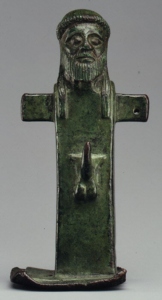
Herms reveal this everyday geography especially well. These pillar-like markers, commonly bearing the head of Hermes and male genitals, stood at roads, gates, boundaries, and public spaces. They protected places where categories met: inside and outside, departure and arrival, one territory and another. Their form can look startling to modern eyes because we separate religion, sexuality, navigation, and civic order into different rooms. The ancient marker did not.
For a traveler, the world beyond the city wall was uncertain. For a merchant, exchange required luck and trust. For a sailor, the sea could erase plans without explanation. Hermes and Poseidon inhabited these exposures. A god did not remove risk. Ritual gave risk a name, an etiquette, and perhaps a companion.
The gods did not make ancient life controllable. They made uncertainty addressable.
Dionysos and the Necessary Loss of Control
Dionysos is often made to carry every fantasy modern people have about ancient intoxication. He deserves more care.
Wine was central to his domain, but wine in Greek culture was rarely only an invitation to drunkenness. It was mixed with water, shared in structured settings, poured for gods, and surrounded by expectations. Dionysos presided over the transformation by which grape becomes wine and the drinker becomes, for a time, less fixed.
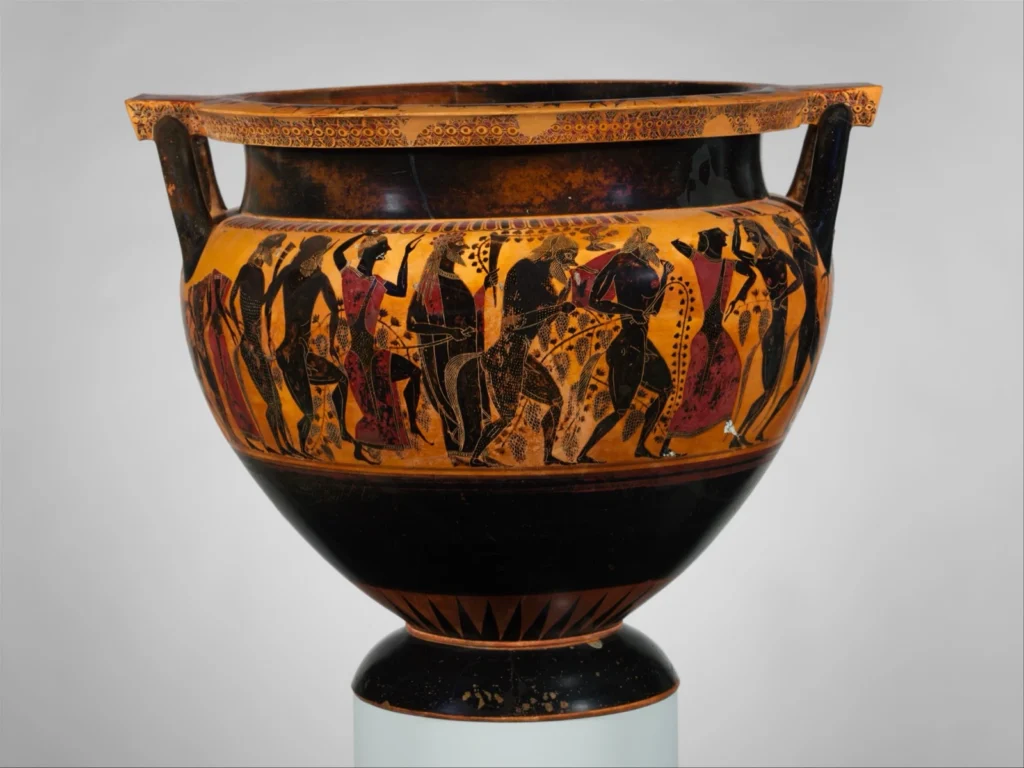
The krater attributed to Lydos shows the god amid satyrs and maenads in the story of Hephaistos’s return to Olympus. Movement travels around the vessel. Music, animality, craft, wine, and reconciliation are joined in procession. The scene is not a photograph of ritual behavior, but it shows how vase painting could think with myth during the very act of communal drinking.
Dionysos also belonged to theater. Athenian dramatic festivals placed tragedy and comedy within his sacred calendar. This matters. The polis did not treat theater as entertainment floating free of religion. Citizens watched stories of ruined households, impossible choices, war, desire, pride, and divine cruelty as part of a festival for the god who unsettles stable identities.
Nietzsche later turned Apollo and Dionysos into philosophical symbols of form and ecstatic dissolution. His pairing is not a neutral description of all ancient Greek religion, but it remains powerful because it notices a real tension: cultures need shape, and human beings sometimes need release from shape. I have written elsewhere about why Nietzsche still matters; here it is enough to say that the ancient god was always richer than the later concept.
Dionysos warns against two simplifications. Civilization is not merely restraint, and ecstasy is not automatically freedom. Either can become destructive. Wisdom may lie in making a place for transformation without pretending we can own it.
Demeter, Persephone, and the Hope Kept Secret
Some religious experiences were public enough to fill a city street. Others depended on secrecy.
The Eleusinian Mysteries, celebrated near Athens for many centuries, centered on Demeter and Persephone. The myth tells of Persephone’s abduction by Hades, Demeter’s grief, the failure of crops, and a negotiated return that is never complete. Daughter and mother are reunited, but separation becomes part of the world’s rhythm.
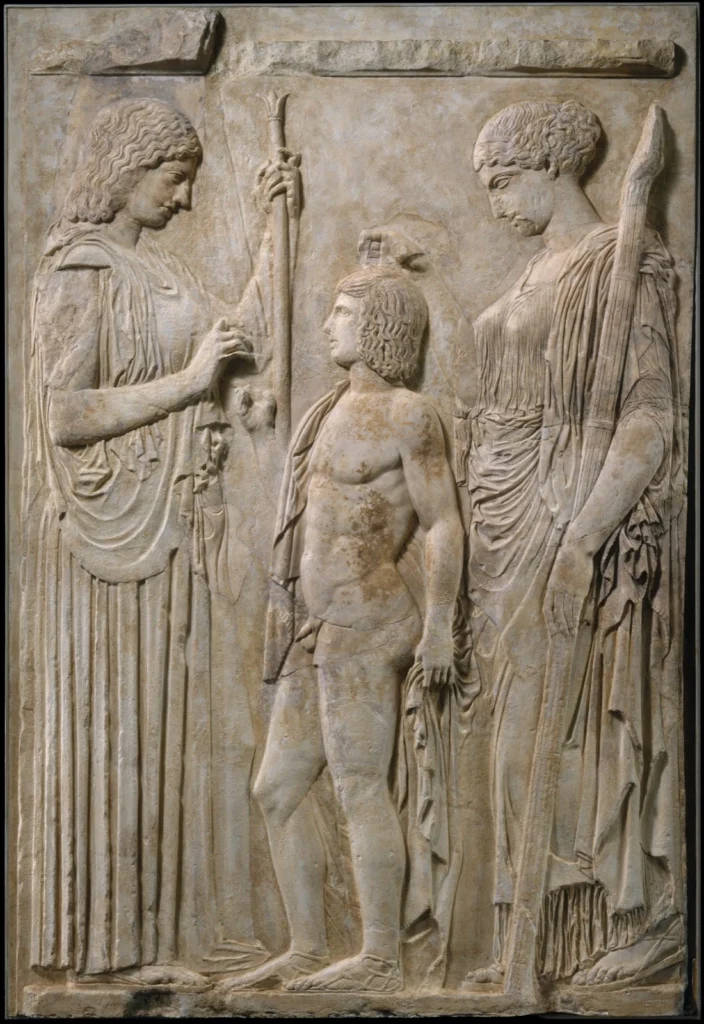
The Great Eleusinian Relief places the youthful Triptolemos between Demeter and Persephone. Demeter appears to give him grain, while Persephone crowns or blesses him. The image joins agriculture to divine gift and human transmission: what grows must be taught, carried, and renewed.
Initiates kept the central rites secret, which means modern certainty should stop at the sanctuary door. Ancient testimony suggests that initiation offered a more hopeful relation to death and the afterlife. We know of processions, fasting, ritual objects, sacred speech, and a climactic experience; we do not possess a complete script. Claims that one particular hallucinogenic substance explains the mysteries remain debated and should not be presented as settled fact.
The silence is part of the history. We live in a culture that assumes knowledge becomes more valuable when broadcast. Eleusis was built around another possibility: some knowledge changes through preparation, participation, and the promise not to expose it.
What Myth Reveals, and What It Cannot Prove
Our evidence for Greek religion comes from genres that ask different questions. Epic poetry is not a festival calendar. Tragedy is not a transcript of ordinary belief. A painted pot is neither a camera nor a theological manual. An inscription may tell us who paid for a dedication while saying almost nothing about what that person felt.
Still, when sources are read together, a fuller world appears:
- Poetry and drama preserve stories, arguments, images, and emotional possibilities.
- Inscriptions record laws, calendars, dedications, offices, expenses, and named acts of worship.
- Sanctuaries and altars show where ritual was organized in space.
- Votive objects reveal what worshippers gave and sometimes why.
- Human and animal remains can illuminate sacrifice, diet, burial, health, and ritual handling.
- Coins, ceramics, and sculpture show how communities made divine identity visible.
The differences among these sources protect us from an easy mistake: treating mythology as the whole of religion. Most worshippers did not spend their days reenacting the adultery, revenge, transformation, and violence of epic tales. They maintained festivals, made vows, marked births and deaths, sought healing, thanked a god for safe travel, and did what their families or cities had long done.
Nor should we imagine that all ancient Greeks were equally devout or philosophically satisfied. Comedy mocked gods and worshippers. Philosophers reinterpreted divine language. Thinkers such as Xenophanes criticized anthropomorphic depictions; Plato worried about the moral effects of inherited stories; Epicureans imagined gods who did not interfere in human affairs. Impiety could become a political charge, but doubt, argument, and revision existed inside Greek culture rather than arriving from modernity.
Why the Gods Survived Their Temples
The ancient cults changed, merged, traveled, and eventually lost their public dominance as the Mediterranean world became Christian. Yet the gods did not vanish. Roman religion identified many Greek deities with Roman counterparts, though Zeus is not simply Jupiter in every historical respect, nor Aphrodite merely Venus under another name. Translation between divine worlds always changes what it carries.
The poems survived. The sculptures were buried, broken, reused, collected, and displayed. Renaissance artists discovered in the gods a language for beauty, desire, power, rivalry, and patronage. Later poets and psychologists found archetypes. Political thinkers found images of order and revolt. Advertisers, film studios, game designers, and technology companies found memorable names.
Something is gained in this afterlife and something is lost. Athena becomes “wisdom,” as if she were a label. Ares becomes “war.” Dionysos becomes “chaos.” The gods survive by becoming portable, but portability strips away the altar, the locality, the festival date, the smell of smoke, the social duty, and the risk.
Perhaps that is why returning to the material evidence matters. A prize amphora is heavier than an archetype. A herm belongs somewhere. A relief was carved for a surface, a sanctuary, a procession, a viewer. Ancient religion was made not only from ideas but from stone, oil, blood, bread, bronze, woven cloth, footsteps, and time.
Sources and Further Reading
The historical framework and object readings in this essay draw on primary texts and museum research. These are good places to continue without turning a living religious world into a collection of disconnected trivia:
- The Metropolitan Museum of Art’s overview of Greek gods and religious practice
- The British Museum’s object-based guide to the Greek and Roman pantheon
- The British Museum record for East Frieze, Block IV of the Parthenon
- The Panathenaic prize amphora attributed to the Euphiletos Painter
- The Lydos krater showing Dionysos and the return of Hephaistos
- The Great Eleusinian Relief
- The Arcadian bronze herm
Living Beneath an Open Sky
I do not think we need to romanticize the Greek gods. Their world could justify hierarchy, exclusion, violence, and fear as readily as ours does. Myth is not morally wise simply because it is old. Some stories remain disturbing, and they should.
Still, there is a seriousness in the ancient refusal to imagine human beings as the only meaningful actors in existence. The sea was not scenery. Grain was not merely a commodity. The hearth was not a household appliance. Desire, intelligence, rage, craft, memory, death, and seasonal return exceeded the person who happened to experience them.
We have gained extraordinary explanatory power by describing these forces without gods. Storms have causes. Crops follow biology and climate. Emotion can be studied without Aphrodite or Ares entering the room. I would not trade that knowledge for superstition.
But explanation can become thin when it imagines that what is measurable is therefore fully understood. The old gods preserved an intuition that human life is relational and exposed. We are shaped by forces we did not invent, dependent on gifts we cannot permanently secure, and responsible for how we meet powers larger than private desire.
Perhaps this is what their stories still place before us. Not a demand to believe again as an Athenian once believed, something neither possible nor honest, but an invitation to notice how much of the world we have made mute.
If the sea, the hearth, the harvest, the road, and the stranger no longer appear sacred to us, what kind of attention might teach us to treat them as though they still were?